We Became a Member of the Union of Small and Medium-Sized Civil Society Organizations
We are pleased to announce that Homo Digitalis is now a member of the Union of Small and Medium-Sized Civil Society Organizations, a dynamic network focused on mutual information-sharing, cooperation, and collective advocacy for an unobstructed and functional civil society environment in Greece.
Together with organizations from diverse fields, ranging from social welfare to culture and education, we are committed to strengthening the voice of Civil Society!
We warmly thank the Union of Small and Medium-Sized Civil Society Organizations for their trust!

Joint Open Letter on the Digital Omnibus Packages to the European Commission
On Wednesday, 19 November, the European Commission will present the new “Digital Omnibus,” a reform that threatens to dismantle fundamental protections of our rights and freedoms in the digital sphere.
In May and October 2025, we warned through open letters that this initiative is part of a broader wave of deregulation that will weaken key European rules, portraying rights as an obstacle to innovation and serving the interests of major technology companies.
A few days ago, leaked draft documents confirmed our fears: the EU is one step away from the largest rollback in the protection of human rights in the digital space. The GDPR, ePrivacy, and even the already weak provisions of the AI Act appear to be targeted for dilution, along with other related legislation.
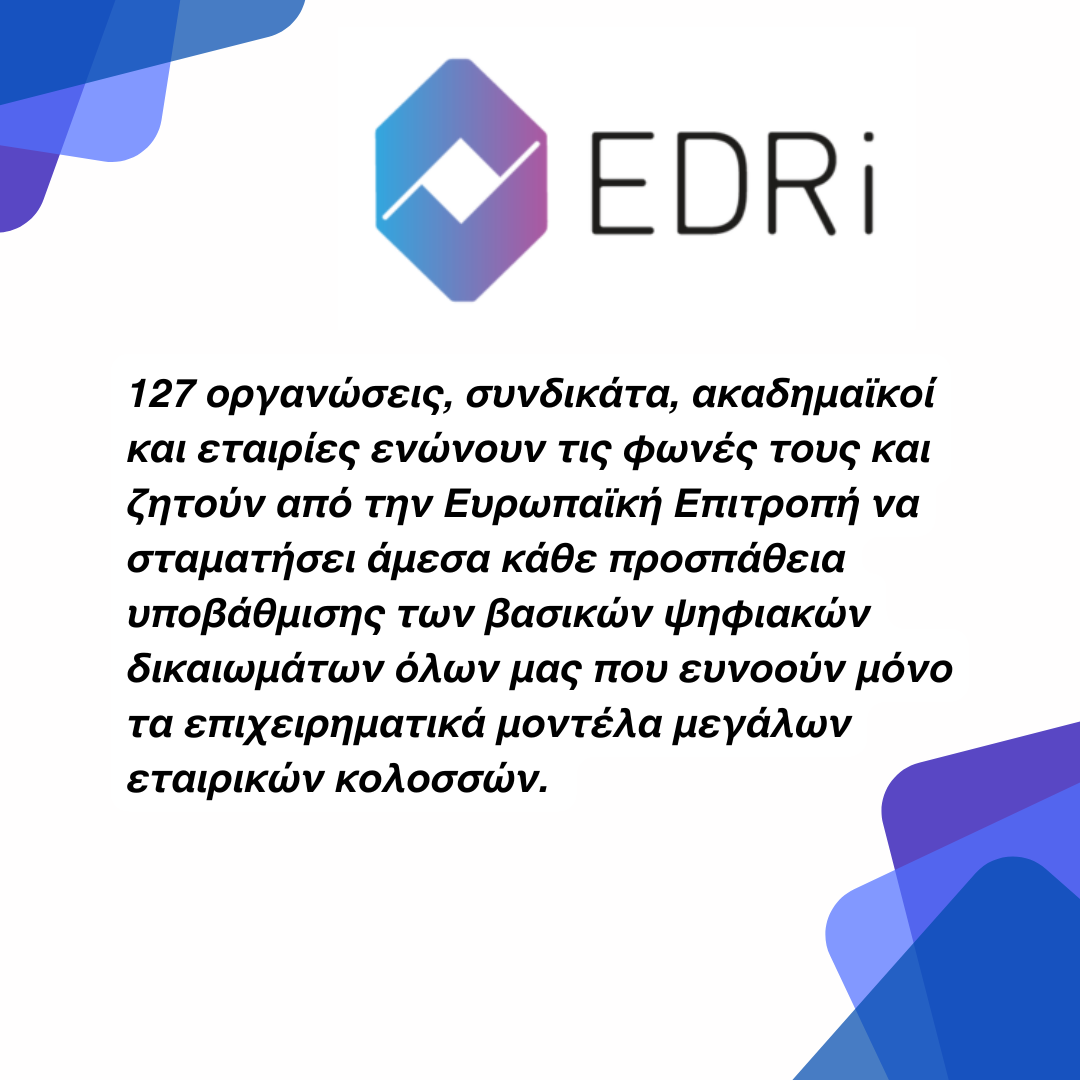
Together with European Digital Rights, 127 organizations, trade unions, academics, and companies are joining their voices and calling on the European Commission to immediately halt any attempt to undermine our fundamental digital rights—efforts that benefit only the business models of large corporate giants.
Read our letter here.
Participation of Homo Digitalis in a Working Group of the European Commission’s AI Office
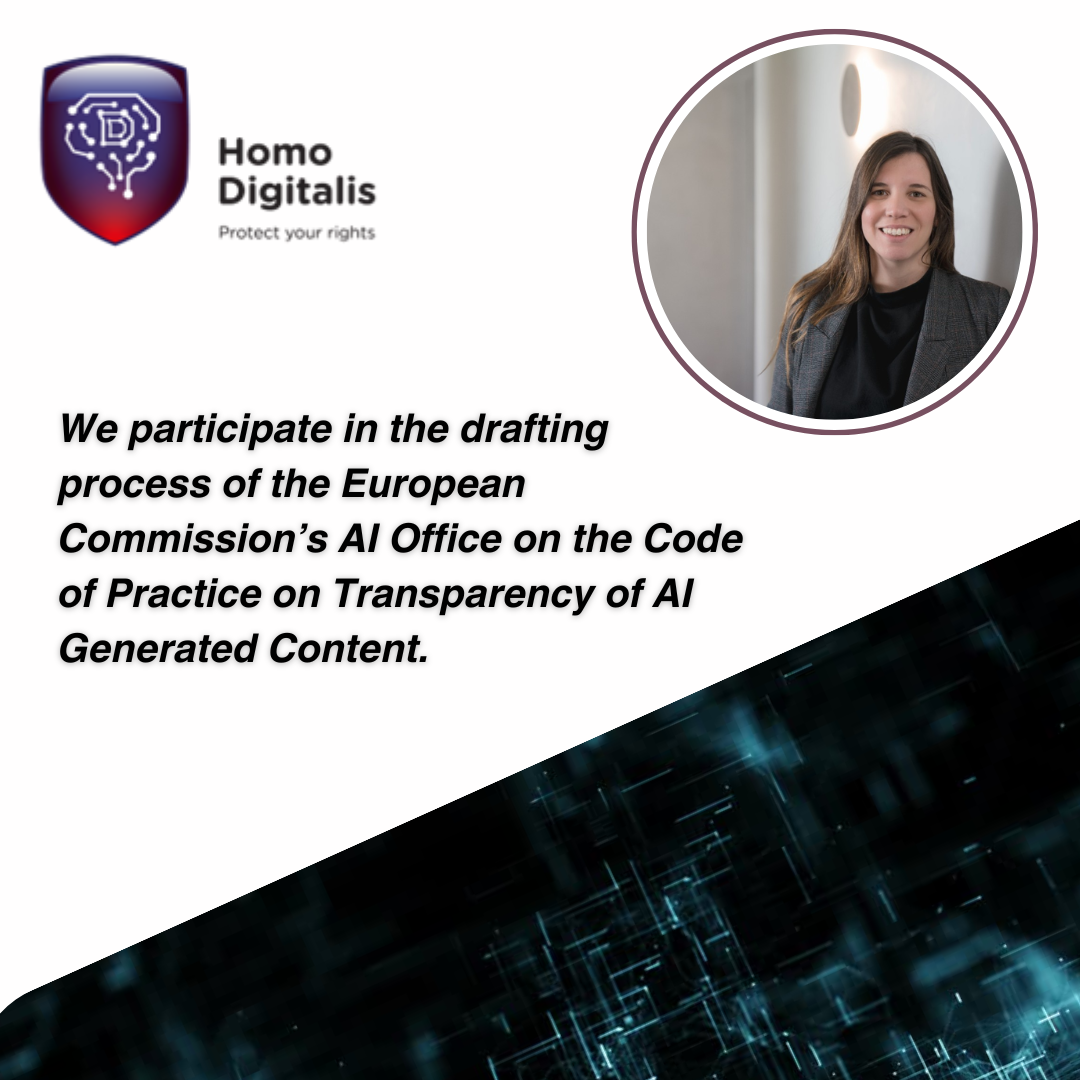
We’re excited to share that last week Homo Digitalis, represented by our member Tania Skrapaliori, participated in the European Commission’s AI Office Kick-off Plenary for the drafting of the Code of Practice on Transparency of AI-Generated Content (Article 50 AI Act).
We are eager to participate in the respective working groups and actively contribute to this process
During the session, participants heard from the AI Office, met the Chairs and Vice-Chairs responsible for drafting the Code, and learn about insights gathered through the recent multi-stakeholder consultation on transparency requirement
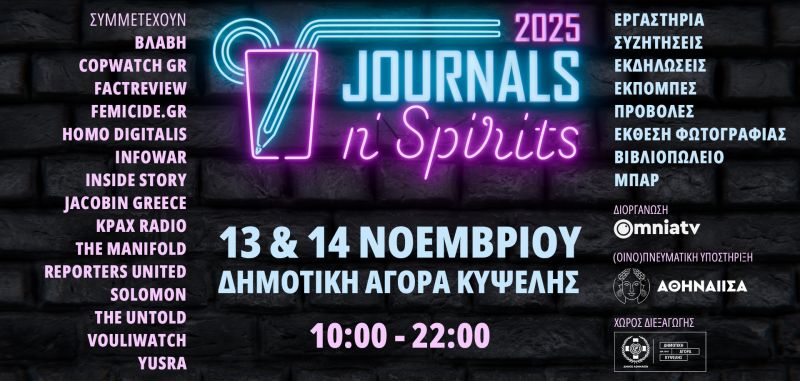
We are co-organizing Journals n’ Spirits 2025 and we look forward to seeing you there!
Join us at Journals n’ Spirits 2025, organized by omniatv at the Kypseli Municipal Market, on November 13 & 14!
Sixteen independent journalism, research, and print media initiatives—including Homo Digitalis—will host workshops, discussions, and live broadcasts. All of this while enjoying our favorite drinks, and, in collaboration with the Skrip Bookstore, publications by members of the participating initiatives will also be available throughout the two-day event.
We will be speaking on November 13 at 14:00 about digital payments and the GNU Taler tool (NGI TALER | Taler Systems S.A.), which is based on the principles of free/libre software and is reshaping the model of electronic micropayments with respect for privacy.
Learn more about the workshops, broadcasts, photo exhibition, and documentary screening in the detailed two-day program available here.
Participating initiatives (in alphabetical order):
Vlavi (magazine), Copwatch GR, FactReview, Femicide.gr, Homo Digitalis, INFOWAR, inside story., Jacobin Greece, KRAX Radio, The Manifold, OmniaTV, Reporters United, Solomon, The Untold, Vouliwatch, YUSRA (magazine/publications).
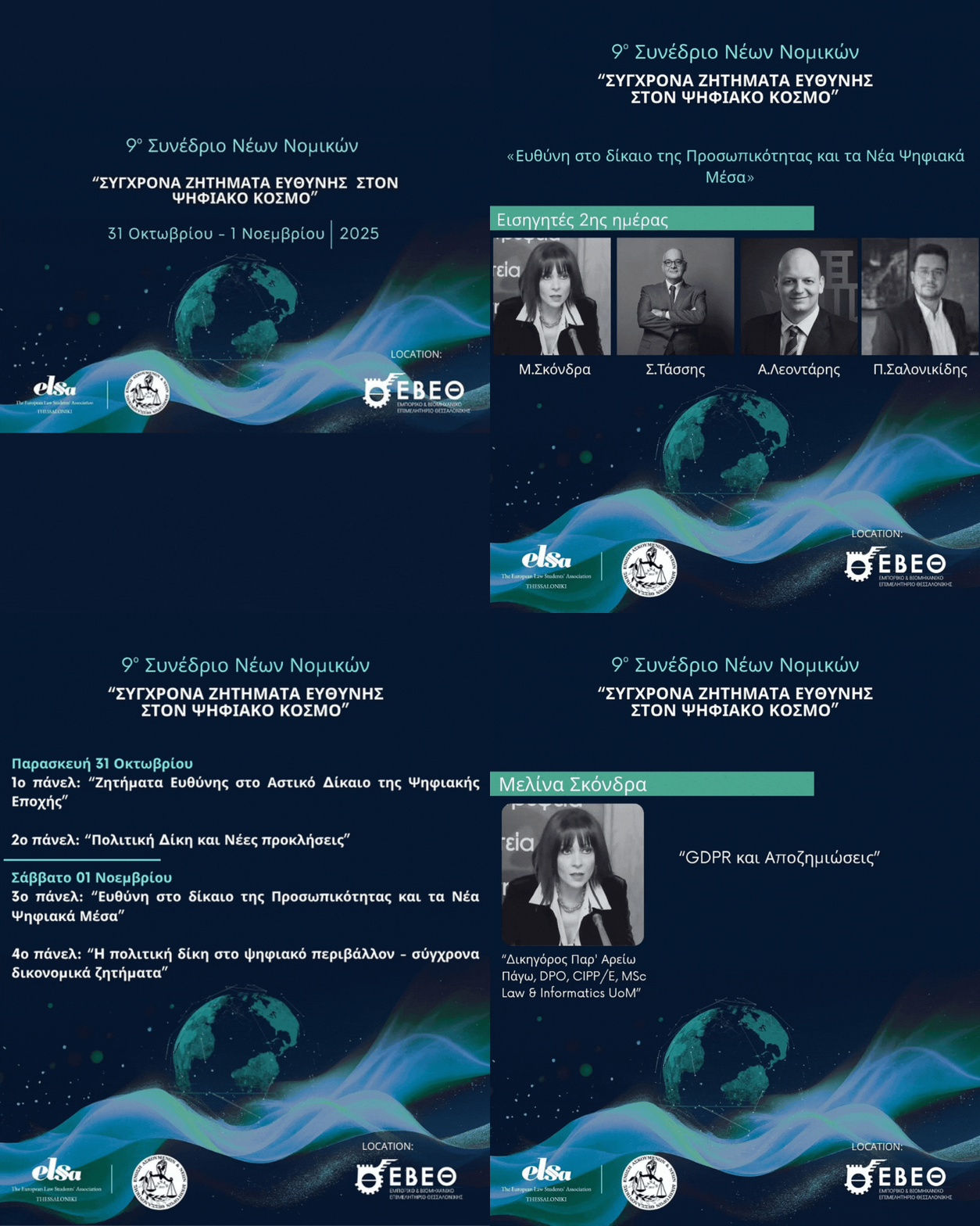
Speech by Homo Digitalis at the 9th Conference of Young Lawyers in Thessaloniki
ELSA Thessaloniki and the Association of Trainee and Young Lawyers of Thessaloniki (EANDiTh) are organizing the 9th Conference of Young Lawyers today and tomorrow at the Thessaloniki Chamber of Commerce and Industry.
It is a great honor for Homo Digitalis to participate in this event, and we sincerely thank the organizers for their kind invitation.
More specifically, tomorrow, November 1, from 10:45 to 12:15, during the first panel of the day entitled “Contemporary Issues of Liability in the Digital World,” our member Melina Skondra will speak.
She is a Lawyer admitted to the Supreme Court, DPO, CIPP/E, and holds an MSc in Law & Informatics (University of Macedonia), with unique specialization in relevant fields.
The title of her presentation is “GDPR & Compensation.”
The line-up of the other speakers includes:
Spiros Tassis, POTAMITISVEKRIS (TMT, Data & IP), Chairman of the Hellenic Data Protection and Privacy Association, and Member of the Board of the European Federation of Data Protection Officers (EFDPO)
Athanasios-Antonios Leontaris, Lawyer / Legal Counsel and Industry Fellow at the Institute for the Future, University of Nicosia
Pavlos Salonikidis, Lawyer admitted to the Courts of Appeal, holder of an LL.M. in International and European Legal Studies, Faculty of Law, Aristotle University of Thessaloniki
We look forward to seeing you there!
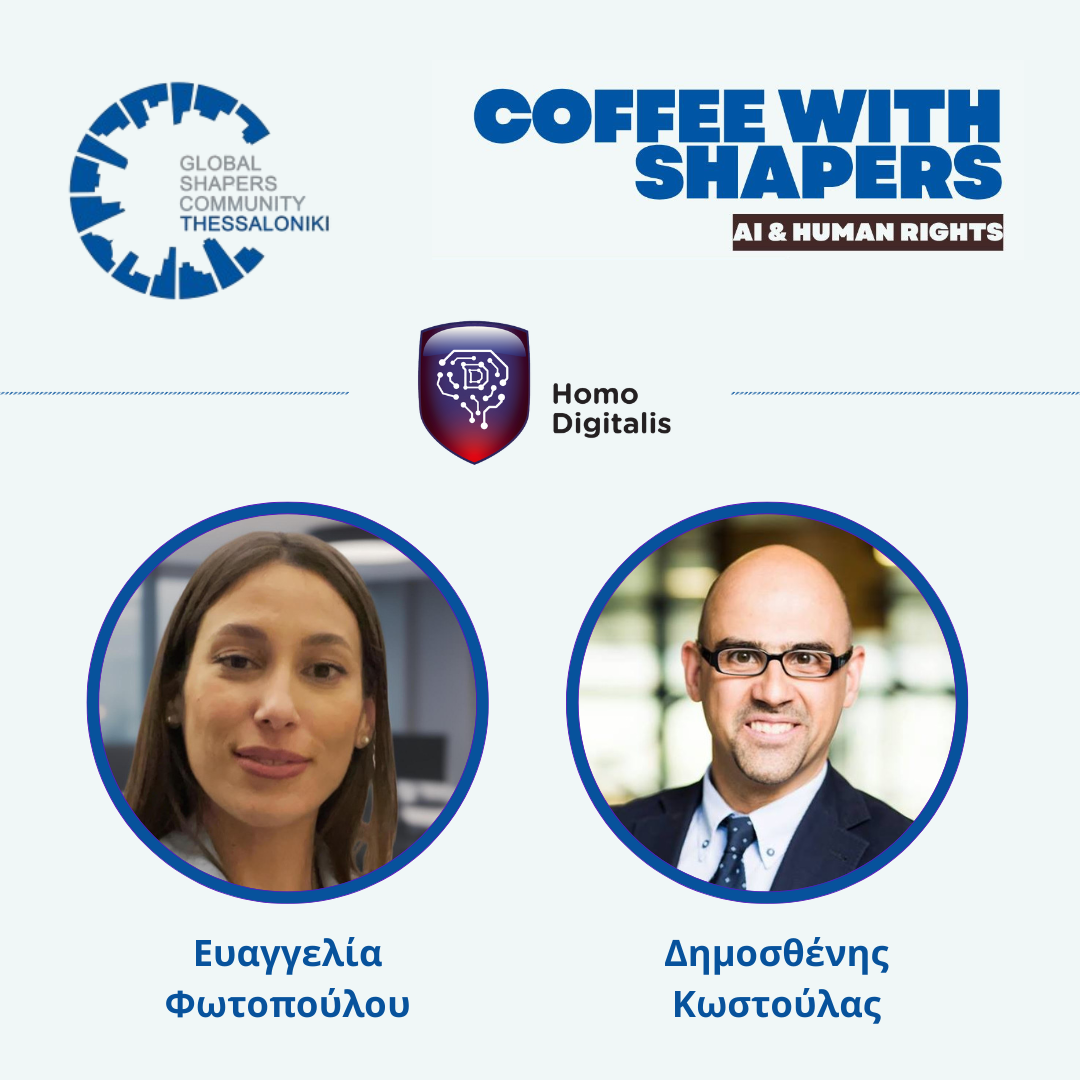
Speech by Homo Digitalis at an event of the Global Shapers Thessaloniki Hub on AI
It is a great pleasure for Homo Digitalis to participate in the Global Shapers Thessaloniki Hub event series, “Coffee with Shapers”!
The theme of the event is AI & Human Rights and it will take place on Saturday, November 1, 2025, from 16:30 to 20:00, at OKTHESS.
Homo Digitalis will be represented by our members Evi Fotopoulou and Dimos Kostoulas.
Admission is free, and the registration form is available here.
We would like to warmly thank the organizing team and Emily Fisher for the kind invitation!
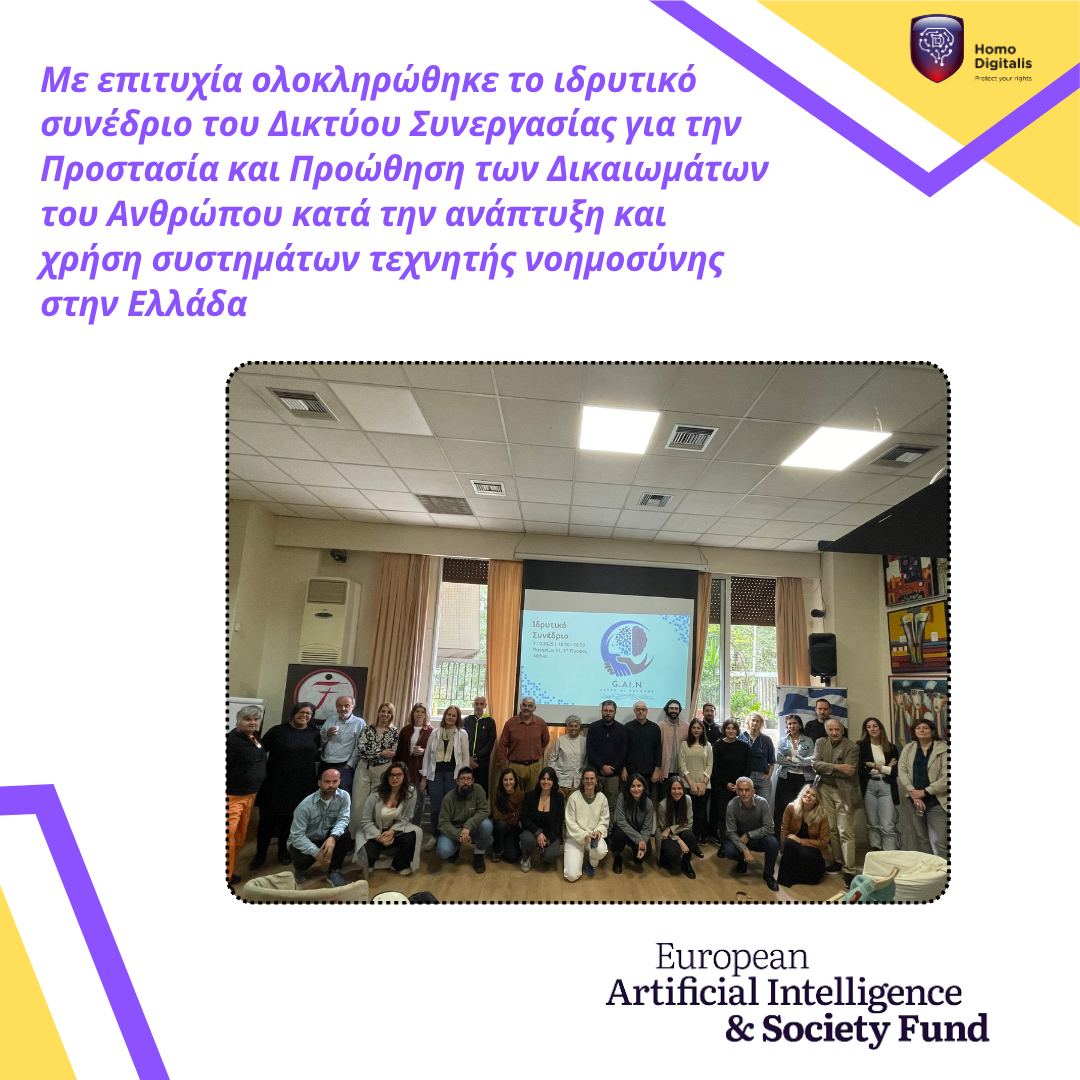
The Founding Conference of the Greek Artificial Intelligence Network – GAIN Successfully Concluded
The founding conference of the Cooperation Network for the Protection and Promotion of Human Rights in the Development and Use of Artificial Intelligence Systems in Greece was successfully completed! The provisional title of the network is Greek Artificial Intelligence Network – GAIN.
The network aspires to become a space for collaboration, knowledge exchange, and mutual support, fostering initiatives in awareness-raising, advocacy, and legal assistance — with the central goal of safeguarding Human Rights in the development and use of Artificial Intelligence systems.
The network’s activities aim to go beyond the minimum legal guarantees, drawing guidance from codes of ethics that emphasize morality, transparency, and accountability in the design, implementation, and evaluation of AI technologies.
The event took place on October 7, 2025, hosted at the offices of the Greek Forum of Migrants, where members and observers of the network had the opportunity to discuss, plan, and lay the foundations for an open, collaborative, and socially responsible AI community in Greece.
During the event, Open Lab Athens delivered an educational presentation on the technical characteristics and materialities of machine learning, significantly contributing to the discussion and collective understanding of the related technologies and their limitations.
The initiative is coordinated by the Homo Digitalis team, with the support of the European Artificial Intelligence & Society Fund (EAISF).
You can read the related Press Release (ΕL) here.
Organizations participating in the network’s processes as members or external observers include (in alphabetical order):
Ανοιχτό Εργαστήριο Αθήνα | Open Lab Athens
Διεπιστημονική Εταιρία Έρευνας στην Αιματολογία – ΔΕτΕΑ
Δίκτυο για τα Δικαιώματα του Παιδιού | Network for Children’s Rights
Ε.Κ.ΠΟΙ.ΖΩ.Ένωση Καταναλωτών «Η Ποιότητα της Ζωής» | Consumers’ Association “The Quality of Life” EKPIZO
Ελληνική Ένωση Δικαιωμάτων του Ανθρώπου | Hellenic League for Human Rights
ΕΛΛΗΝΙΚΟ ΣΥΜΒΟΥΛΙΟ ΓΙΑ ΤΟΥΣ ΠΡΟΣΦΥΓΕΣ | GREEK COUNCIL FOR REFUGEES
Ελληνικό Φόρουμ Μεταναστών | Greek Forum of Migrants
Εταιρεία Περιφερειακής Ανάπτυξης και Ψυχικής Υγείας – ΕΠΑΨΥ | Association for Regional Development and Mental Health – EPAPSY
Ένωση Πληροφορικών Ελλάδος
Ινστιτούτο Έρευνας Ρυθμιστικών Πολιτικών – ΙΝΕΡΠ | Institute for Regulatory Policy Research – INERP
Κέντρο ΔΙΟΤΙΜΑ
ΚΥΤΤΑΡΟ ΕΝΑΛΛΑΚΤΙΚΩΝ ΑΝΑΖΗΤΗΣΕΩΝ ΝΕΩΝ – ΚΕΑΝ | CELL OF ALTERNATIVE YOUTH ACTIVITIES
Με Άλλα Μάτια | Me Alla Matia
Οργανισμός Ανοιχτών Τεχνολογιών – ΕΕΛΛΑΚ | Open Technologies Alliance (GFOSS)
ΠΑΡΑΤΗΡΗΤΗΡΙΟ ΑΣΤΥΝΟΜΕΥΣΗΣ copwatch.gr
AMKE REVMA – ROMA EDUCATIONAL VOCATIONAL MAINTAINABLE ASSISTANCE
Athens Network of Collaborating Experts -ANCE
DATAWO
ERGO.Academy
HIAS Greece
Homo Digitalis
I Have Rights
In contACT
inside story.
KnowledgeRights21 (National coordinator for Greece and Cyprus)
OmniaTV (iCase Κοιν.Σ.Επ.)
Reporters United
SolidarityNow
Solomon
VISIBLE MACHINES
Vouliwatch
WHEN Equity Empowerment Change
WWF Greece
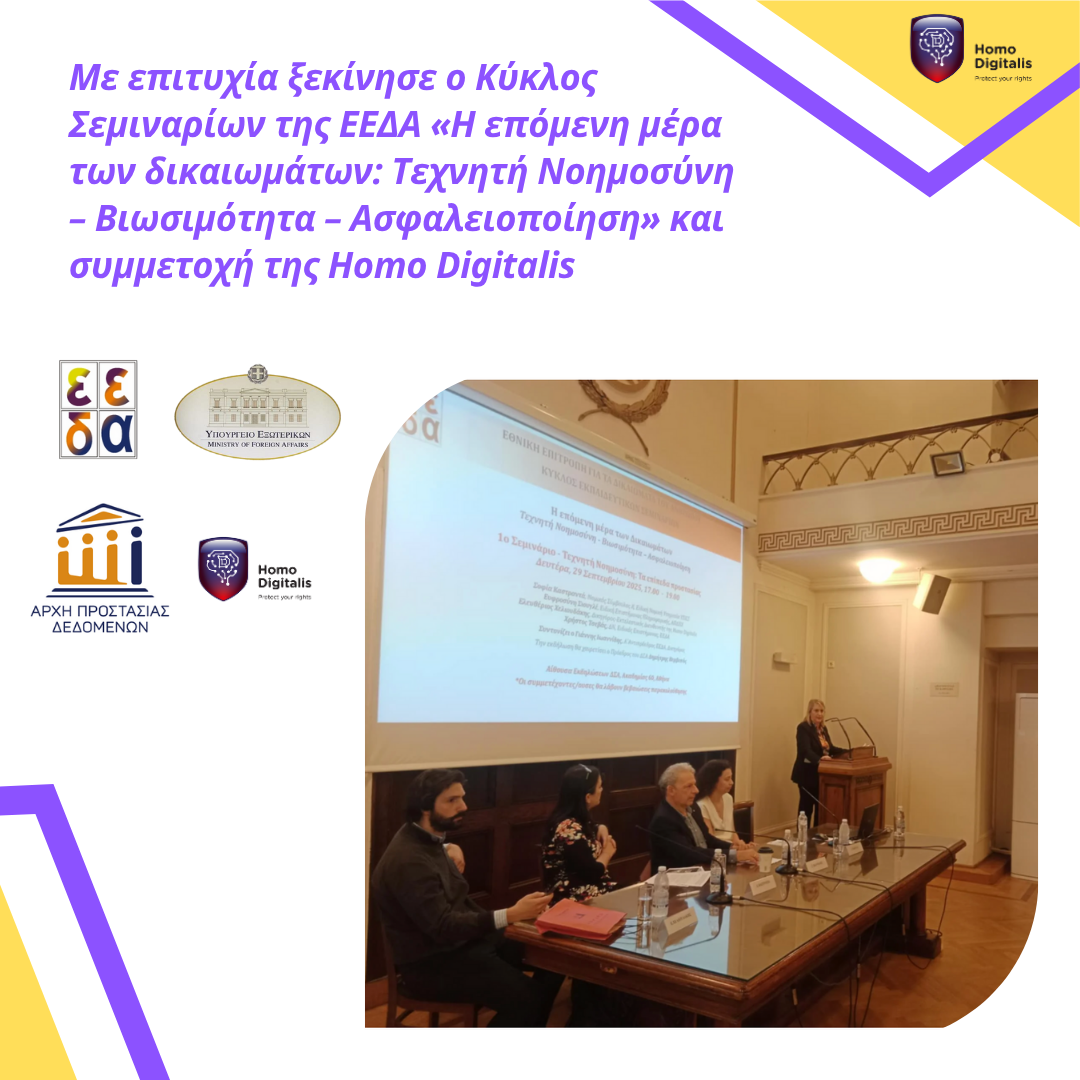
Homo Digitalis speaks at the 1st Seminar of the GNCHR Educational Seminar Series on “Artificial Intelligence: Levels of Protection”
With great success and active public participation, on Monday, September 29, 2025, the opening event of the Educational Seminar Series of the Greek National Commission for Human Rights (GNCHR) took place in the event hall of the Athens Bar Association (DSA), under the theme:
“The Next Day of Rights: Artificial Intelligence – Sustainability – Securitization.”
Homo Digitalis had the great honor of contributing with a presentation in the first seminar of the series, titled “Artificial Intelligence: Levels of Protection.”
Opening remarks were delivered by Marinetta Gounari–Chatzisarantou, Vice President of the Athens Bar Association, while the event was moderated by Giannis Ioannidis, First Vice President of the GNCHR.
Speakers at the seminar included, in order:
Sofia Kastranta, Senior Legal Advisor, Special Legal Service of the Ministry of Foreign Affairs
Dr. Efrosini Siougle, Expert Scientist in Informatics, Head of the Advisory and Compliance Mechanisms Department of the Hellenic Data Protection Authority
Eleftherios Chelioudakis, LL.M, M.Sc, Lawyer and Executive Director of Homo Digitalis
Dr. Christos Tsevas, Expert Scientist of the GNCHR
We warmly thank the Greek National Commission for Human Rights for the kind invitation to participate!
You can watch the full event here.
The second seminar will take place at the Athens Bar Association on Monday, October 13, from 17:00 to 19:00, on the topic: “Artificial Intelligence: Rights.”
Find more information here.
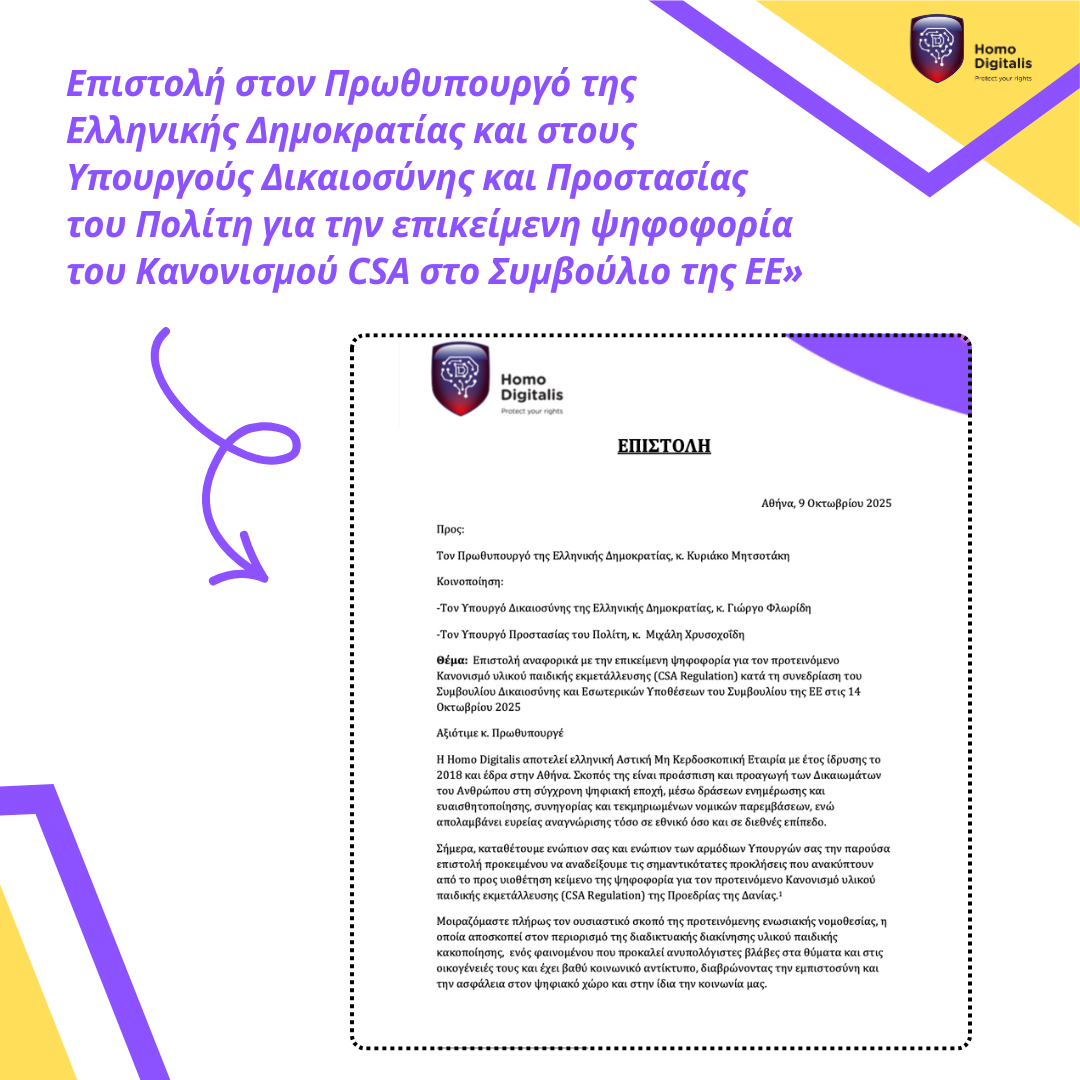
We submit an Open Letter to the Prime Minister, calling on the Hellenic Republic to reject the Danish Presidency’s text on the CSA.
Homo Digitalis today submitted an Open Letter to the Prime Minister of the Hellenic Republic, Kyriakos Mitsotakis, regarding the proposed Regulation on Child Sexual Abuse Material (CSA Regulation).
In our letter — which we have also shared with the Minister of Justice and the Minister for Citizen Protection — we call on the Hellenic Republic to reject the Danish Presidency’s text in the upcoming vote at the EU Justice and Home Affairs Council on October 14, 2025.
The objective of the Regulation — to curb the distribution of child sexual abuse material — is right and necessary. However, the text proposed by the Danish Presidency would achieve the opposite effect, undermining security and trust in the digital space.
Specifically, 787 leading experts in communication security and encryption — including professors from top academic institutions in Greece — have emphasized that:
The technology for detecting child sexual abuse material is inaccurate and ineffective.
Mandatory scanning undermines end-to-end encryption and opens the door to mass surveillance.
The proposed technical measures can be easily bypassed by malicious users and threaten anonymity and freedom of information.
Real child protection comes through education and support for victims, not through mass monitoring.
On October 14, Greece’s position must be guided by knowledge, technical expertise, and the fundamental principles and values upheld by the EU Charter of Fundamental Rights and the Constitution of Greece.
You can read the full text of our open letter here.
You can also read a related article recently published on our website by our member Stergios Konstantinou here.
Learn more about Homo Digitalis’s work on this issue, including past meetings between our members — Haris Kyritsis, Haris Daftsios, Niki Georgakopoulou, Giorgos Sarris, and Angelina Barla — and Greek Members of the European Parliament, in cooperation with European Digital Rights (EDRi), here.