
Homo Digitalis in Brussels to speak at two important events

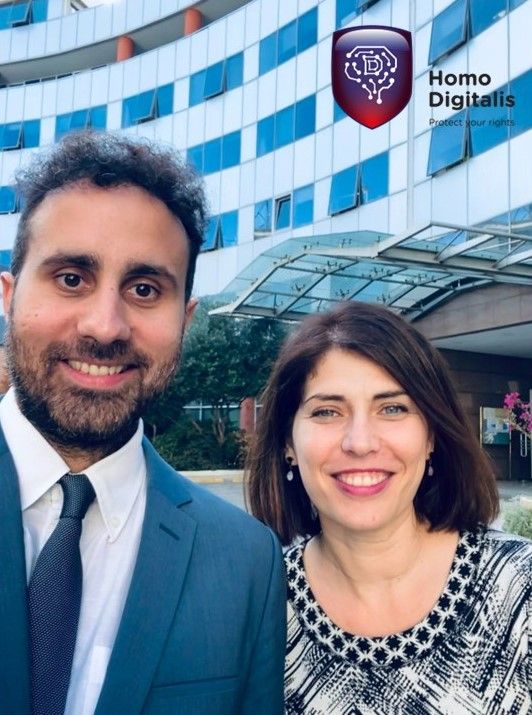
Homo Digitalis made a lightning trip to Brussels this week!

There we attended the annual plenary meeting of the Justice, Equity & Technology (JET) Table at The London School of Economics and Political Science (LSE), which we have been members of for more than 2.5 years now, studying the implications of using technologies to defend specific social groups based on class and race.

We also successfully participated for another year in FreedomNotFear, where we had the great pleasure to organise a talk regarding the use of intrusive technologies in the field of border protection and our related legal actions for 2019-2023.

For Homo Digitalis, our Board Secretary, Eleftherios Chelioudakis, travelled from Greece to Brussels


Drones & Artificial Intelligence at Greece’s high-tech borders

By Alexandra Karaiskou

In recent years, Greece has been investing significant funds and effort to modernize its border and migration management policy as part of the digitalization of its public sector. This modernization comes in a techno-solutionist shape and form which entails, as the term reveals, an enormous trust in technological solutions for long-standing and complex problems. In the field of border and immigration control, this includes the development, testing and deployment of advanced surveillance systems at the Greek borders, its refugee camps, and beyond to monitor unauthorized mobility, detect threats, and alert authorities for rapid intervention. While these technologies can bring noteworthy benefits, such as more coordinated and rapid responses in emergency situations that could prove critical for saving someone’s life, they also come with significant human rights risks. They can be also used to conduct more frequent and ‘effective’ pushbacks further away from the borders in more invisible and indetectable ways. Significant risks also exist for the rights to privacy, data protection, non-discrimination, and due process, which are undoubtedly among the first to be adversely impacted by the rollout of such technologies.

Although this techno-solutionist trend is not solely a Greek but a global phenomenon, its concretization in the Greek geo-political sphere, a country which manages a considerable portion of Europe’s south-east external borders, is illustrative of the future of European and Member States’ digital border and migration management policies. Technology has “become the ‘servant mistress of politics’”, as Bonditti has eloquently put it, which raises serious concerns about how these systems will be used in practice once deployed, given the systemic pushback and other non-entrée practices documented in the Aegean and Mediterranean seas. And while these technologies are being tested and deployed in a regulatory vacuum, the stakes become even higher.

REACTION: Greece’s latest border surveillance R&D project

As a country traditionally faced with important migratory and refugee inflows due to its geographical location, Greece has gained interest in research and innovation (R&D) projects developing border surveillance technologies. In the past 6 years, it has participated in more than nine EU co-funded projects as a research partner and/or a testing ground, including in the famous ROBORDER, CERETAB and AIDERS projects. In brief, these projects aim at developing various technologies, such as drones and other autonomous robotic vehicles equipped with multimodal cameras; automated early warning systems and innovative information exchange platforms; as well as algorithms (software) that can analyse real-time data and convert it into actionable information for national authorities. Their overall objective is to improve situational awareness around the borders and states’ interception capabilities and preparedness for emergency responses.

Having followed these developments closely from the outset, it came as no surprise when we saw yet another border surveillance project uploaded on the Greek Migration Ministry’s website last fall. This time it is REACTION, a project building on the findings of all the above projects, and co-funded by Greece, Cyprus, and the EU Integrated Border Management Fund. It aims at developing a next generation platform for border surveillance which can provide situational awareness at remote frontier locations as an efficient tool for rapid response to critical situations. Responding to irregular immigration, smuggling, human trafficking and, overall, transnational organised crime is described as the main driver behind the development of REACTION. The system will consist of several components, such as drones that can be used in swarm or solo formations, computer vision (via deep learning techniques), object recognition, identification and characterisation of events, early warning systems, as well as big data analytics. In simpler terms, software trained on machine learning techniques will analyse instantly the vast amounts of data collected by the drones and other sensors connected to the system and produce an alert identifying the type of incident and its coordinates. Depending on its design features, it may also offer additional tools to the authorities, such as the possibility to follow an unidentified object or person, zoom in and potentially cross-reference their distinctive features (ex. a person’s facial image) with data stored in existing databases. It is worth noting that REACTION will be interoperable with the servers of the Greek law enforcement authorities, and Reception and Identification Centres (RICs, i.e. refugee camps, analysed below), as well as EUROSUR, the EU border surveillance system operated by the EU Border and Coast Guard Agency, thereby drawing a wealth of information from various national and European sources.

Such systems come with the hope of revolutionising border management by elevating authorities’ detection and intervention capabilities to the next level. To what end, whether to save lives or let die, remains to be seen. Unfortunately, the country’s recent track record in emergency responses at the border, as evidenced by the recent shipwreck off Pylos and numerous other pushback incidents, leaves little room for optimism. Moreover, the deployment of such a tool might also undermine the right to privacy and data protection, among others, to the extent that anyone approaching the border could become a potential target of surveillance, whose sensitive biometric data could be unknowingly processed. It may still be soon to tell how this system will be implemented in the future, but the widening of power asymmetries between state authorities and vulnerable individuals along with the current state of practice paint a very alarming picture.

Hyperion & Centaur: the new surveillance systems at Greece’s refugee camps

Another area where new surveillance technologies are being piloted is Greece’s refugee camps. The Greek Ministry of Migration currently develops seven projects for the digitalisation of the asylum procedure and the camps’ management. One of them, Hyperion, which is expected to be deployed soon, will be the new management system of all the RICs, closed centres, and shelters. It will register asylum seekers’ personal data, both biographic (ex. full name, date and country of birth, nationality, etc.) and biometric (fingerprints), and will be the primary tool for controlling their entry in and exit from the camp by scanning their asylum seeker’s card and a fingerprint. It will also store information about most services provided to them, such as food, clothing, etc., and their transfers from one camp to another. In the near future, asylum seekers’ moves will be closely and continuously scrutinized by this system, as if they were inmates in high security prisons, which leads to highly intrusive practices that are difficult to justify. Besides surveillance, another objective of Hyperion is to enforce strict discipline to the state’s power: if someone, for instance, leaves the camp and does not return within the authorised time period, they could lose their access to the camp and to the rest of the services provided to them, leaving them homeless and without the most basic living conditions. Noteworthily, Hyperion will also be interoperable with an asylum seeker’s digital case file at the Asylum Service, which means that any alert in the system about a breach of the camp’s rules may have negative implications on their asylum claim. In the example above, unjustified absence from the camp could lead to the rejection of their asylum application, exposing them to the risk of detention and deportation.

In addition, Centaur is the new high-tech security management system of the camps that will automatically detect security breaches and alert the authorities. It consists of drones, optical and thermal cameras, microphones, metal detectors, and advanced motion detectors based on AI-powered behavioural analytics that monitor the internal and surrounding area of the camp. It is connected to a centralised control room in the Ministry’s headquarters in Athens and produces red flags whenever a security threat is detected, such as fights, unauthorized objects, fires, etc. From there, Ministry employees can zoom in and assess the risk, and instruct personnel on the ground on where and how to intervene. It has already been piloted at several camps and works complementarily to Hyperion by surveilling whatever move has been left unmonitored. In practice, the only places where people can enjoy some privacy is the bathrooms and to a certain extent the insides of their rooms. In the words of the 25-year-old refugee living in Samos camp: “there’s not a lot of difference between this camp and a prison”.

Although these systems have been promoted by the Greek authorities as efficient tools to ensure asylum seekers’ safety, this certainly comes at a high cost for privacy and fundamental rights. Besides their right to privacy, which is obviously seriously restricted, their right to non-discrimination or due process could be adversely affected, if the use of these systems leads to biased decisions or summary rejections of asylum applications. Moreover, their right to data protection is also severely compromised. Importantly, no Data Protection Impact Assessment seems to have been conducted, although required by the GDPR; and no regulatory framework has been adopted yet to govern the use (and potential misuse) of these systems, and mitigate these and other human rights risks. While the Ministry’s radio silence on these issues echoes loudly, we look forward to the findings of the Greek DPA’s investigation and trust them to ensure the protection of all persons’ rights in the digital era, regardless of where they are coming from.

Four steps to compliance today

Although the deadlines are further down the line, affected organizations do not have to sit and wait. Time (and money) is precious when preparing to achieve compliance with the NIS2 and DORA requirements. Organizations must assess and identify actions they can take to prepare for the new rules.

The following recommendations are a good starting point:

Governance and risk management: Understand the new requirements and evaluate the current governance and risk management processes. Additionally, consider increasing funding for programs that help detect threats and incidents and strengthening enterprise-wide cybersecurity awareness training initiatives.

Incident reporting: Evaluate the maturity of incident management and reporting to understand current state capabilities and gauge awareness of the various cybersecurity incident reporting standards relevant to your industry. You should also check your ability to recognize near-miss situations.

Resilience testing: Recognize the talents needed to design and carry out resilience testing, including board member training sessions on the techniques used and their implications for repair.


FRONTEX responds to Homo Digitalis' Request for Access to Information on EUROSUR and the deadly shipwreck in Pylos

In June 2023, Homo Digitalis had filed a request for access to documents before FRONTEX in order to explore whether the EUROSUR system, which is composed of drones and satellites, among other technologies, was in operation during the fatal ship’s voyage from 9 to 13 June in the Mediterranean Sea and the reasons why it did not prevent this fatal shipwreck.

Today, FRONTEX replies that the EUROSUR system, despite being fully operational, has not been able to do what it promises, namely to detect large vessels that may be used by criminal organisations to transport people in the Mediterranean, putting the lives of the latter at high risk. This is a major revelation by Homo Digitalis, demonstrating that the very expensive – tens of millions of euros – solutions promised by technology companies to complex issues such as border management and the protection of people who put their lives at risk have failed. EUROSUR failed to locate the large floating vessel, despite the fact that it had been right in its field of control for more than 3 full 24 hours.

You can see the text of the reply we received here.


Homo Digitalis talks to Athens 9.84

Margarita Mytilineou is one of the most acclaimed radio producers of the last decades.

Tomorrow morning, she welcomes Lambrini Gyftokosta, Director of Artificial Intelligence & Human Rights at Homo Digitalis, for a discussion on the topic “Can our mobile phone finally listen to us?”

Tune in to learn more about the ads we see every day everywhere on the Internet.
-Why are they different for each of us?
-How much does it affect us?
-How much is it legal?


Homo Digitalis talks to Inside.Story about the microphone of our mobile phone

Can the mobile phone finally hear us?

Many people believe that the mobile phone microphone is recording us without our knowledge, for advertising purposes. So is this a conspiracy theory or reality?

To inside story. and journalist Rafaela Maneli today published an article analyzing the relevant issues, with the participation of Homo Digitalis’ Director for Artificial Intelligence and Human Rights issues, Lamprini Gyftokosta, in it. You can read the article here.

Thank you very much for the interview and the interest in our actions!


Homo Digitalis co-organizes with the Digital Freedom Fund the Strategic Litigation Meeting for the first time in Greece!

The Digital Freedom Fund’s Strategic Litigation Meeting is back!

In collaboration with Homo Digitalis and with funding from Luminate, the retreat will take place in Athens from September 11-14. If you are planning to take legal action against major tech companies or other class actions, register now here.

The retreat hosts training sessions and workshops aimed at developing participants’ legal skills and tactics in a relaxed and collaborative environment with other colleagues. DFF also hopes to be able to sponsor some of the cases that participants develop during the meeting.

After two online versions due to the COVID-19 pandemic, DFF is pleased to bring the event back to its true essence as an in-person retreat where participants can disconnect from other activities and commitments to work in depth on the study and strategic planning of their cases.

In the latest post on the DFF blog, legal counsel César Manso-Sayao shares more details about the retreat, as well as some thoughts regarding recent developments on the liability of large platforms. Read it here.

Artwork by Kruthika N.S.


We call on the European Parliament, the European Commission and the Council of the EU to prioritise fundamental rights over profits

As the EU institutions move forward in “trilogue” negotiations, the last stage for the adoption of the proposed EU legislation on AI #AIAct, we are taking a stand again!

150 civil society organisations, including Homo Digitalis, are calling on the European Parliament, the European Commission and the EU Council to put people and their fundamental rights ahead of profits!

In the coming period we intend to take initiatives in this regard at national level as well! You can read our letter here.


Homo Digitalis participates again in an event of the Greek KnowledgeNet Chapter of IAPP

Next Thursday, 13/7, at 19:00, Homo Digitalis will have the great pleasure and honor to be present at the event of the Greek KnowledgeNet Chapter of the IAPP – International Association of Privacy Professionals on “Managing the rights of data subjects”.

There we will be represented by our new Director in Artificial Intelligence & Human Rights issues, Lambrini Gyftokosta, in a panel in which Ms. Kalli Karveli, Legal Auditor, at the Data Protection Authority and Mr. Evangelos Katsaras Senior Associate, ALG MANOUSAKIS LAW FIRM will participate.

We would like to thank the organizers for the invitation and the interest in our actions! You can find out more about the venue of the event on its official page here.


Now you can watch our talk at CPDP2023

Would you like to watch what Homo Digitalis said at the CPDP Conferences 2023, but you were not there??

No problem! The presentation of Stergios Konstantinou, who represented us, is freely available!

You can watch it here.