Homo Digitalis successfully participated in a scientific online event on the Digital Omnibus package
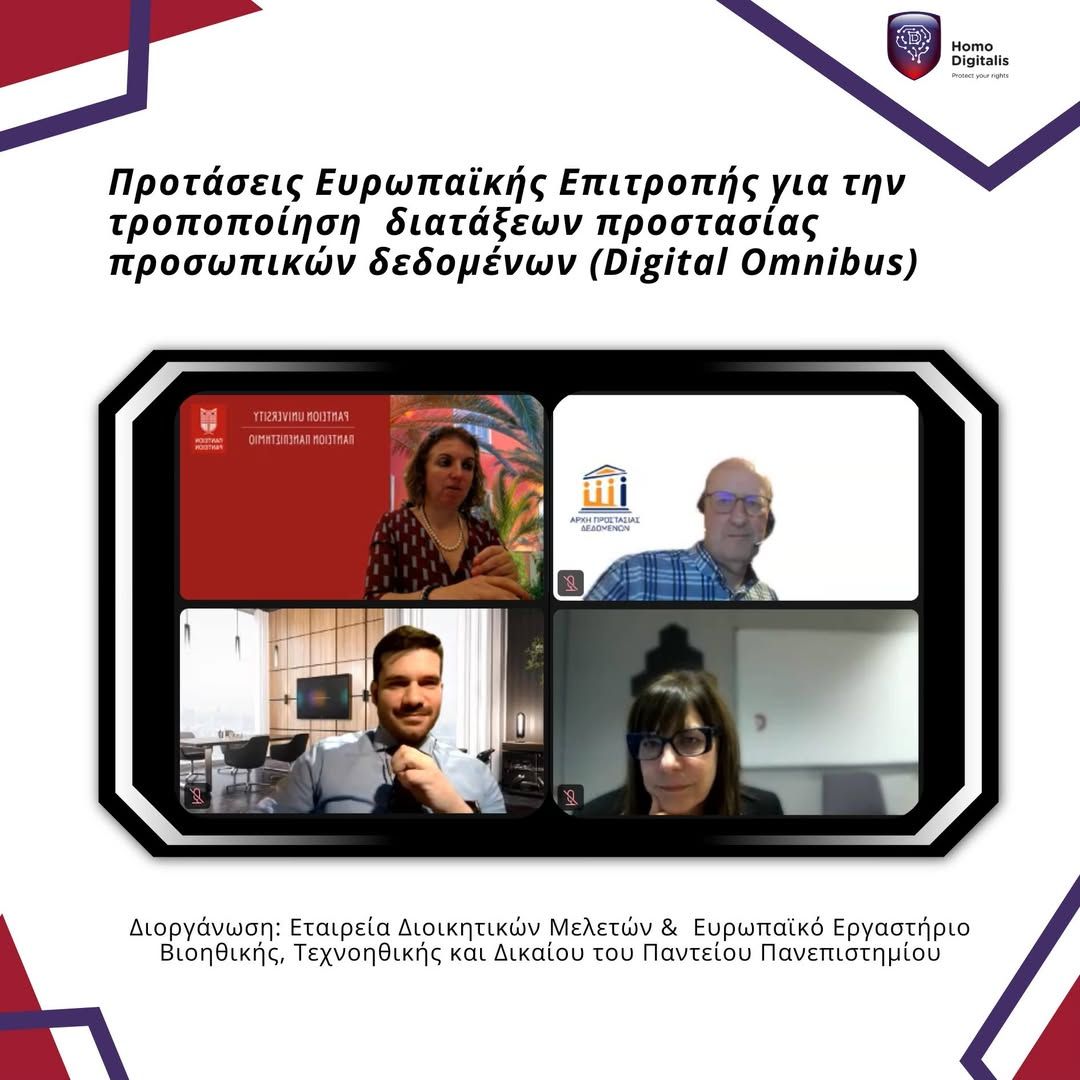
On Thursday, February 26, 2026, Homo Digitalis had the honor of delivering a presentation at a scientific online event organized by the Society of Administrative Studies in collaboration with the European Laboratory for Bioethics, Technoethics and Law of Panteion University, on the topic of the European Commission’s proposals to amend provisions on personal data protection (Digital Omnibus).
Homo Digitalis was represented by Stefanos Vitoratos, while presentations were also delivered by Dr Giorgos Rousopoulos (Hellenic Data Protection Authority) and Dr Zoe Kardasiadou (Official at the European Commission, Directorate-General for Justice and Consumers).
The discussion was moderated by Dr. Fereniki Panagopoulou-Koutnatzi, Associate Professor at Panteion University, while opening remarks were delivered by Dimitrios Skaltsounis, President of the Society of Administrative Studies and former President of the Council of State.
We express our warm thanks to the organizers for the honorable invitation and for the opportunity they offered us to participate in a fruitful dialogue and a meaningful exchange of arguments and views.

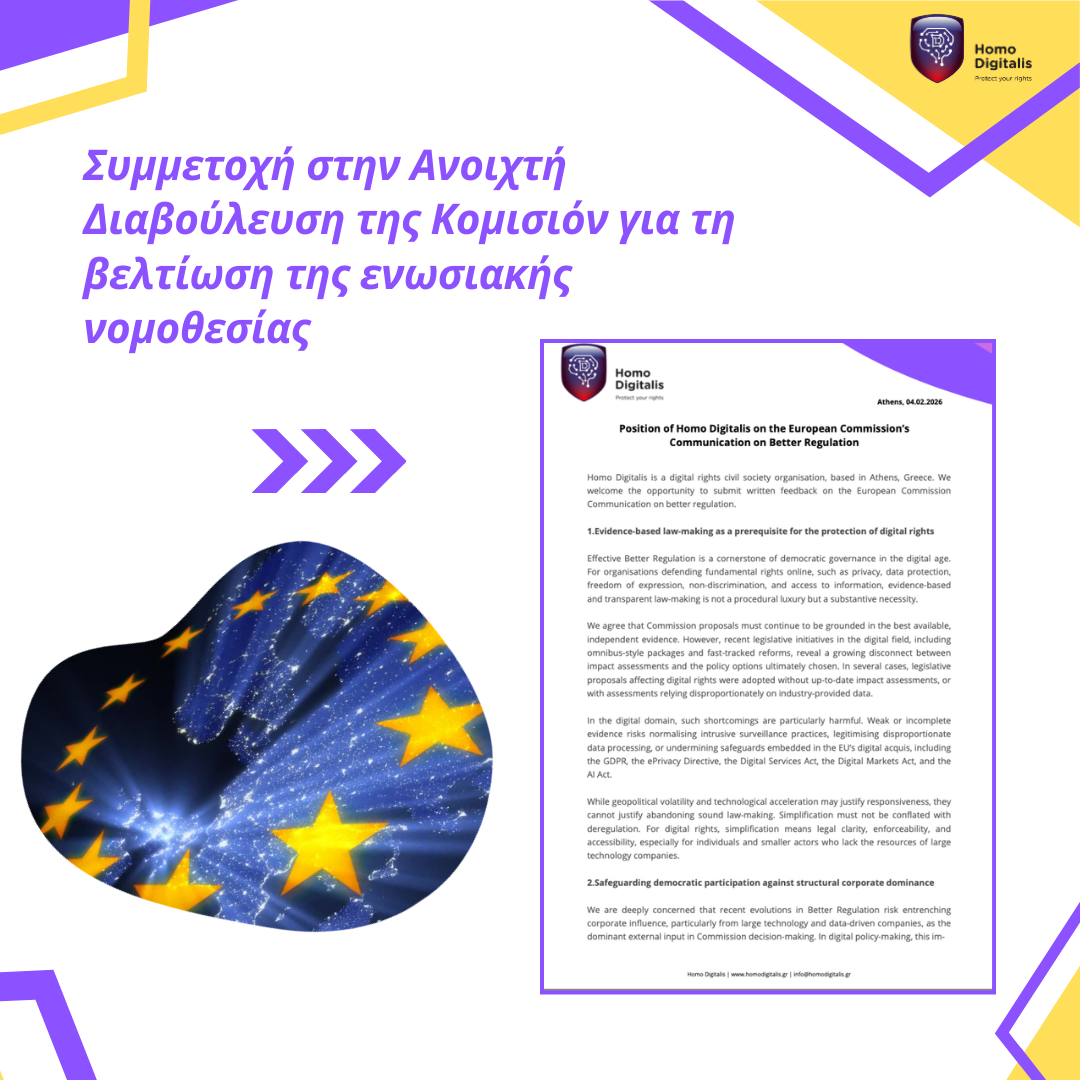
Homo Digitalis participates in the European Commission’s open public consultation on improving EU legislation
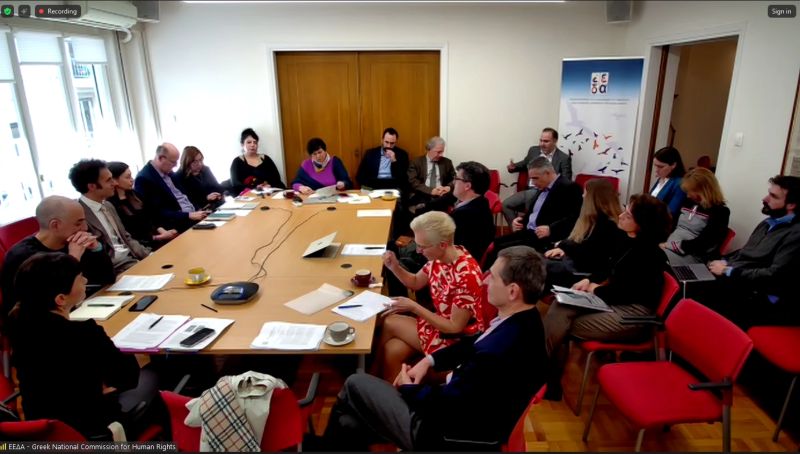
Yesterday, 4/2, marked the conclusion of the submission process for contributions to the European Commission’s open public consultation on the “Better Regulation” initiative.
In our detailed submission, we emphasize that evidence-based, data-driven, and participatory lawmaking is a prerequisite for the digital future of Europe and its market.
While we recognize the need for rapid responses in a rapidly evolving technological environment, we highlight a steadily widening gap between evidence-based analyses and final legislative choices. This phenomenon is particularly evident in recent horizontal initiatives of the Omnibus type, as well as in fast-tracked reforms that are launched on uncertain and unclear foundations.
Read here our submission on the Commission’s website.
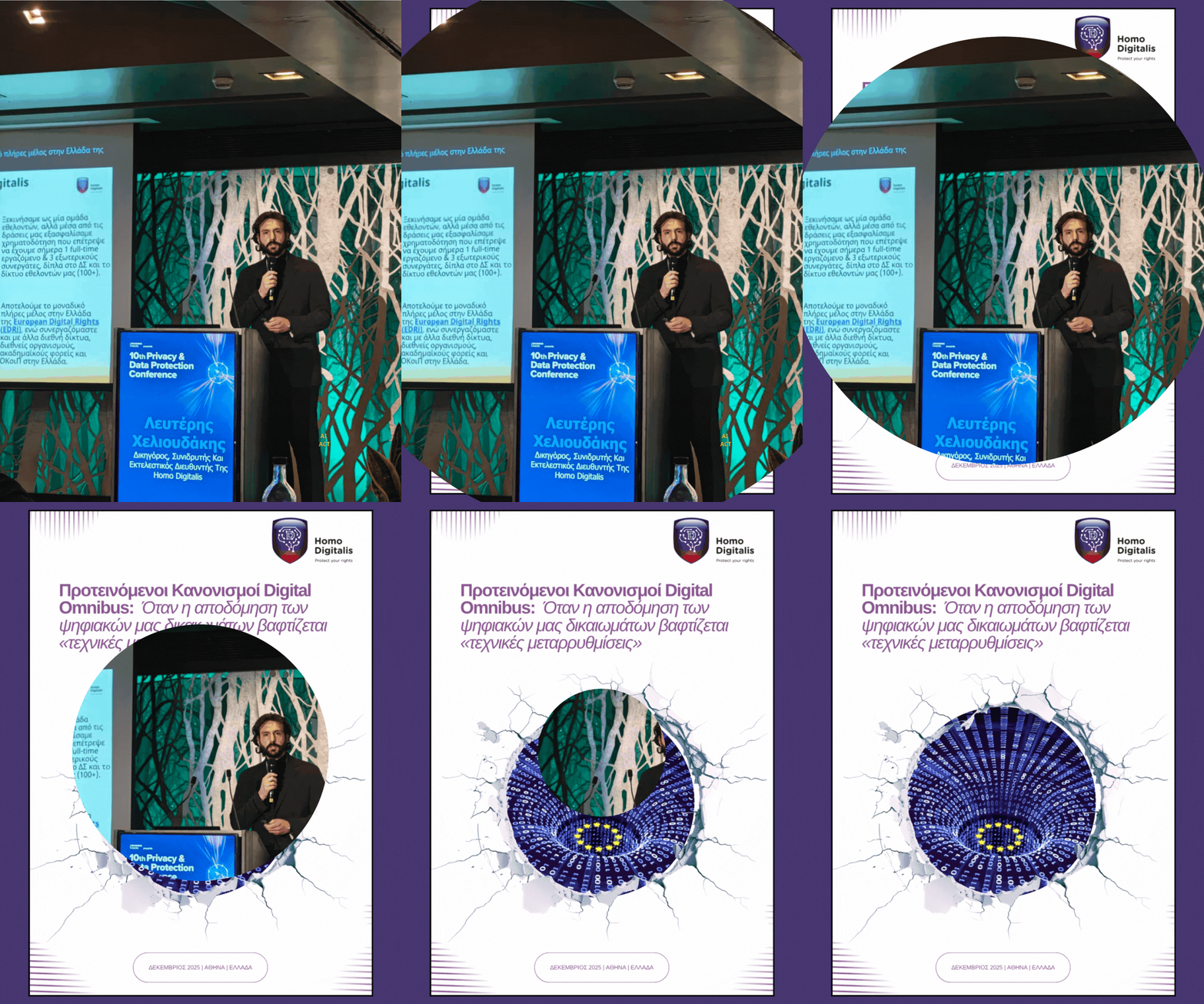
We presented our Study on the Digital Omnibus package at the Privacy & Data Protection Conference
Last Friday, Homo Digitalis was invited to the Privacy & Data Protection Conference, organized by BOUSSIAS.
There, our Executive Director, Eleftherios Chelioudakis, presented our Study on the Digital Omnibus reform packages, highlighting the challenges that the proposed changes pose to our rights in the contemporary digital era.
You can read our Study here.
We would like to warmly thank the conference organizers, and especially Alexandra Varla, for the very honorable invitation. Congratulations as well to all the speakers for their insightful contributions.
.
Homo Digitalis & EDRi speak to inside story on the proposed Digital Omnibus regulations
Ιs Europe moving away from the protection of our digital rights?
inside story. and journalist Eliza Triantafyllou published an in-depth article on Monday, December 1, examining the European Commission’s Digital Omnibus proposals. European Digital Rights (EDRi) and Homo Digitalis had the honor of contributing comments and arguments, represented by their members Blue Duangdjai Tiyavorabun, Ella Jakubowska (she/her), Itxaso Domínguez de Olazábal, PhD, and Eleftherios Chelioudakis.
Is the EU giving in to pressure from Trump and major technology companies to deregulate rules protecting Europeans’ personal data and privacy, rebranding it as “simplification”? What exactly do the two recent proposals include? Read the article here.
We warmly thank the journalist for her interest in our arguments.

Homo Digitalis gives an interview on ATHINA 9.84
This Friday, November 28, at 19:30, tune in to ATHINA 9.84!
Homo Digitalis is delighted to be a guest on the radio show of the Hellenic League for Human Rights, where we will talk about our work in the field of digital rights.
Our Co-founder and Treasurer of the Board, Konstantinos Kakavoulis, will represent us, while the show will be hosted by Taygeti Michalakea, Board Member of the Hellenic League for Human Rights.
We warmly thank them for the kind invitation and the honorable interest in our work!

Press Release on today’s announcement of the Digital Omnibus packages:
The proposed provisions of the Digital Omnibus were made public today, placing our rights and the safeguards protecting us in the digital environment at serious risk.
These new proposed regulations threaten the core of the European data protection framework and a range of other digital rights, directly affecting key instruments such as the GDPR, the ePrivacy Directive, and the AI Act.
The European Commission’s broader deregulation agenda primarily serves the interests of large technology companies, sidelining fundamental rights. Through these choices, the European Commission is effectively deviating from its mission and failing to fulfil its institutional responsibility.
We call on the Council of the European Union and the European Parliament to reject this attempt to dismantle the European framework for Digital Rights, and instead to focus on the consistent and effective enforcement of the rules that are already in place.
Read our full press release here.
Joint Open Letter on the Digital Omnibus Packages to the European Commission
On Wednesday, 19 November, the European Commission will present the new “Digital Omnibus,” a reform that threatens to dismantle fundamental protections of our rights and freedoms in the digital sphere.
In May and October 2025, we warned through open letters that this initiative is part of a broader wave of deregulation that will weaken key European rules, portraying rights as an obstacle to innovation and serving the interests of major technology companies.
A few days ago, leaked draft documents confirmed our fears: the EU is one step away from the largest rollback in the protection of human rights in the digital space. The GDPR, ePrivacy, and even the already weak provisions of the AI Act appear to be targeted for dilution, along with other related legislation.
Together with European Digital Rights, 127 organizations, trade unions, academics, and companies are joining their voices and calling on the European Commission to immediately halt any attempt to undermine our fundamental digital rights—efforts that benefit only the business models of large corporate giants.
Read our letter here.