
Homo Digitalis publishes its Study on the proposed Digital Omnibus Regulations
On 19 November, the European Commission published two (2) proposed Digital Omnibus Regulations.
The first (Digital Omnibus Regulation Proposal) proposes significant amendments to provisions of well-known legislative instruments that are already in force, such as the General Data Protection Regulation (GDPR – Regulation 2016/679), the Data Protection Regulation for the EU institutions, bodies, offices and agencies (EUDPR – Regulation 2018/1725), the ePrivacy Directive (Directive 2002/58/EC), the Data Act (Regulation 2023/2854), the Single Digital Gateway Regulation (Regulation 2018/1724), the NIS2 Directive (Directive 2022/2555) and the Critical Entities Resilience Directive (Directive 2022/2557).
It also proposes the repeal of other legislative instruments that are currently in force, namely the Regulation on the free flow of non-personal data (Regulation 2018/1807), the Data Governance Act (Regulation 2022/868), the Regulation on platform-to-business relations (P2B – Regulation 2019/1150) and the Open Data Directive (Directive 2019/1024).
The second (Digital Omnibus on AI Regulation Proposal) proposes significant amendments to legislation that is currently partially in force, in particular the Artificial Intelligence Act (AI Act – Regulation 2024/1689), while also introducing additions to legislation that is fully in force, specifically the Regulation establishing common rules in the field of civil aviation (Regulation 2018/1139).
Homo Digitalis, together with the European network of which it is a member, European Digital Rights (EDRi), as well as other civil society organisations, academics and experts, sought throughout 2025 to maintain a substantive and well-documented presence in the relevant legislative preparatory process. In this context, we submitted a series of open letters to the competent bodies of the European Commission in May, September and November, while at the same time setting out our positions and arguments in detail through active participation in the public consultation process in October 2025.
We had already warned that the Digital Omnibus package forms part of a broader wave of deregulation that threatens to weaken critical European rules, portraying fundamental rights as an alleged obstacle to innovation and, in practice, serving the interests of large technology companies. From the outset, we had no confidence that the European Commission would be able to genuinely absorb and process our positions within the framework of the public consultation, because the consultation closed in mid-October and the publication of the final text with the proposed provisions was expected just one month later. It would have been essentially impossible to analyse and incorporate arguments and proposals into the text within such a short timeframe.
By November 2025, it had become clear that the European Commission was never interested in substantive dialogue and exchange of views regarding this legislative initiative. At that point, a leak of certain drafts of the proposed provisions revealed that the Commission had already shaped a draft regulation containing highly problematic provisions, representing the greatest rollback in the protection of human rights in the digital sphere. We then highlighted, through a joint press release, the significant challenges arising from the proposed changes to the GDPR and the ePrivacy Directive. A few days later, the official text was published, concealing new surprises and even greater challenges for our rights and freedoms in the digital environment.
Today, we publish our in-depth study on the package of proposed Digital Omnibus reforms, explaining the challenges that arise for our rights and freedoms.
The text of our study is available here (EL).
The Digital Omnibus reform package is not a technical exercise in codification, but a decisive shift of the European digital acquis towards a regime of reduced safeguards and diminished accountability. If adopted as is, the Union risks losing the strongest tool it possessed internationally: the example that technological progress can coexist with high standards of fundamental rights protection.
This weakening will not be felt through dramatic ruptures, but through a slow and persistent erosion, whereby rights we considered non-negotiable will be transformed into exceptions, and oversight will become a shadow of its former self. The choice facing EU legislators does not concern the “simplification” of legislation, but the very future of the European model of human protection: whether it will remain a pillar of the rule of law or allow itself to be replaced by a logic in which innovation is imposed without counterbalances and privacy becomes negotiable.

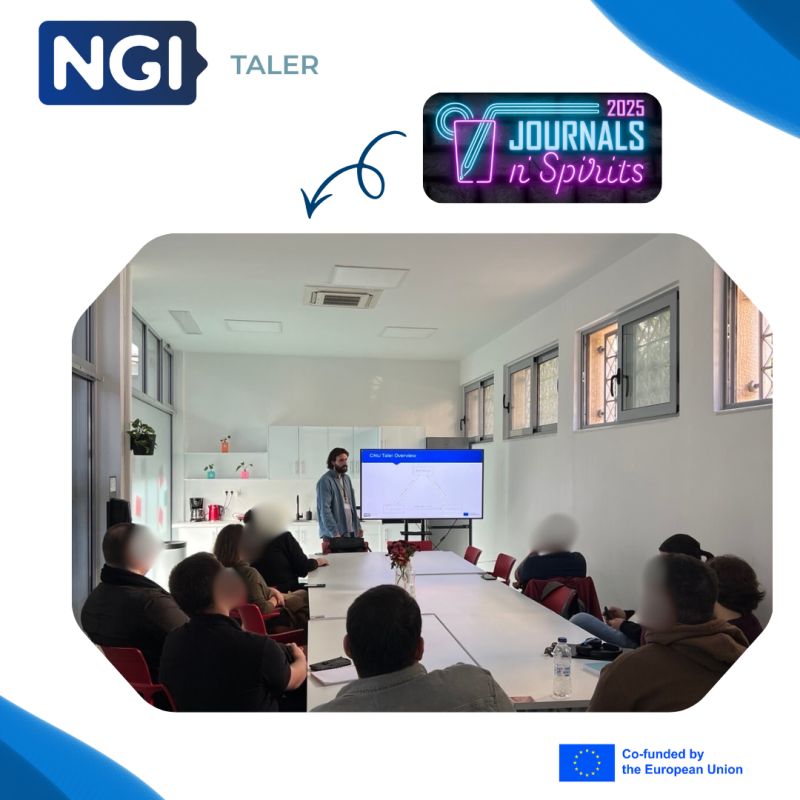
Our NGI TALER workshop at Journals n’ Spirits 2025 was successfully completed
On November 13, we represented NGI TALER at Journals n’ Spirits 2025, which was organized by omniatv together with the initiatives Vlavi (magazine), Copwatch GR, FactReview, Femicide.gr, Homo Digitalis, INFOWAR, inside story., Jacobin Greece, KRAX Radio, The Manifold, Reporters United, Solomon, The Untold, Vouliwatch, and YUSRA (magazine/publications), at the Kypseli Municipal Market.
More specifically, Eleftherios Chelioudakis from our team presented the GNU TALER digital payments tool, which functions like digital cash and radically reshapes the ecosystem of electronic micropayments. It is based on the principles of free/libre software and strict respect for privacy, offering a new way to conduct online financial transactions while ensuring full accountability.
We also spoke about the funding opportunities provided by NGI TALER for everyone who can contribute to our important mission. Do you have relevant ideas? Submit your application by February 1, 2026, here.
Homo Digitalis & EDRi speak to inside story on the proposed Digital Omnibus regulations
Ιs Europe moving away from the protection of our digital rights?
inside story. and journalist Eliza Triantafyllou published an in-depth article on Monday, December 1, examining the European Commission’s Digital Omnibus proposals. European Digital Rights (EDRi) and Homo Digitalis had the honor of contributing comments and arguments, represented by their members Blue Duangdjai Tiyavorabun, Ella Jakubowska (she/her), Itxaso Domínguez de Olazábal, PhD, and Eleftherios Chelioudakis.
Is the EU giving in to pressure from Trump and major technology companies to deregulate rules protecting Europeans’ personal data and privacy, rebranding it as “simplification”? What exactly do the two recent proposals include? Read the article here.
We warmly thank the journalist for her interest in our arguments.
We successfuly concluded our pre-litigation project with DFF on electronic communications metadata retention
We are excited to announce that Homo Digitalis has successfully concluded its pre-litigation project on the mass surveillance of electronic communications metadata in Greece, funded by the Digital Freedom Fund (DFF).
With the support of this grant, we carried out extensive legal and institutional research into Greece’s data-retention and surveillance framework. This included an in-depth analysis of Law 3917/2011 and a thorough assessment of all potential legal avenues to challenge the existing regime. As part of the project, we developed the legal arguments, collected evidence, and built the strategic foundation required for future litigation.
This project is a crucial step toward protecting the privacy and digital rights of over 14 million people in Greece. With the pre-litigation groundwork complete, we are now preparing the next phase: strategic litigation and advocacy efforts!
We thank the Digital Freedom Fund for their support and for standing with organisations fighting to uphold democratic freedoms across Europe. Read our papers and learn more on a piece prepared by Thomas Vink here
.

The 11th NGI TALER Open Call for funding is here! Help us spread the word!
Do you have a groundbreaking idea for free/libre software and privacy-preserving projects that support the mission of NGI TALER? Missed the first nine funding calls? No problem!
The 11th Open Call for funding launched on December 1, 2025, and you have about two months to apply! The deadline is February 1, 2026, at 12:00 noon (Central European Time).
We are looking for proposals that will revolutionize digital payment systems and contribute to an open, trustworthy, and secure internet for all.
We offer funding ranging from €5,000 to €50,000! Whether you are an SME, academic, public body, non-profit organization, community, or individual, we want to hear your innovative ideas!
You can strengthen GNU Taler through:
Development of supporting tools,
User experience improvements,
Integrations with FOSS applications,
Infrastructure enhancements (e.g. subsystems for merchants), and much more!
For more information about this and other calls of NGI – The Next Generation Internet, visit its website.
Read the full Call, the Guide for Applicants, the Eligibility Criteria, the FAQs, and submit your application on the NLnet Foundation website.
Join the TALER Integration Community Hub (TALER ICH) developed by petites singularités to ask questions and network.
Need inspiration? Check out 17 successful projects already collaborating with us here.

Homo Digitalis gives an interview on ATHINA 9.84
This Friday, November 28, at 19:30, tune in to ATHINA 9.84!
Homo Digitalis is delighted to be a guest on the radio show of the Hellenic League for Human Rights, where we will talk about our work in the field of digital rights.
Our Co-founder and Treasurer of the Board, Konstantinos Kakavoulis, will represent us, while the show will be hosted by Taygeti Michalakea, Board Member of the Hellenic League for Human Rights.
We warmly thank them for the kind invitation and the honorable interest in our work!

Homo Digitalis at an Expert Workshop on the Evaluation of AI Models
In mid October, Homo Digitalis had the great honor of taking part in an expert workshop that took place at the Weizenbaum Institute, contributing to an exciting initiative on participatory and community-oriented hashtagAIauditing.
Researchers Goda Klumbytė (University of Kassel) and David Hartmann (Technische Universität Berlin) conducted stakeholder interviews and a co-design workshop to collaboratively develop a toolkit that supports civil society organisations in understanding and auditing AI/GenAI systems more effectively.
Our team presented our methodology for investigating the lack of legal compliance in AI and GenAI systems, showcasing key successes from our national-level legal battles.
We also discussed our ongoing initiative to co-create a network of civil society organisations in Greece, uniting expertise and resources to build trust and collaborate in pushing back against intrusive GenAI tools. Maria Mouchika and Eleftherios Chelioudakis represented Homo Digitalis at this event.
We extend our warm thanks to the organisers for their kind invitation and for fostering a collaborative environment in academia where civil society voices help shape meaningful AI accountability practices.
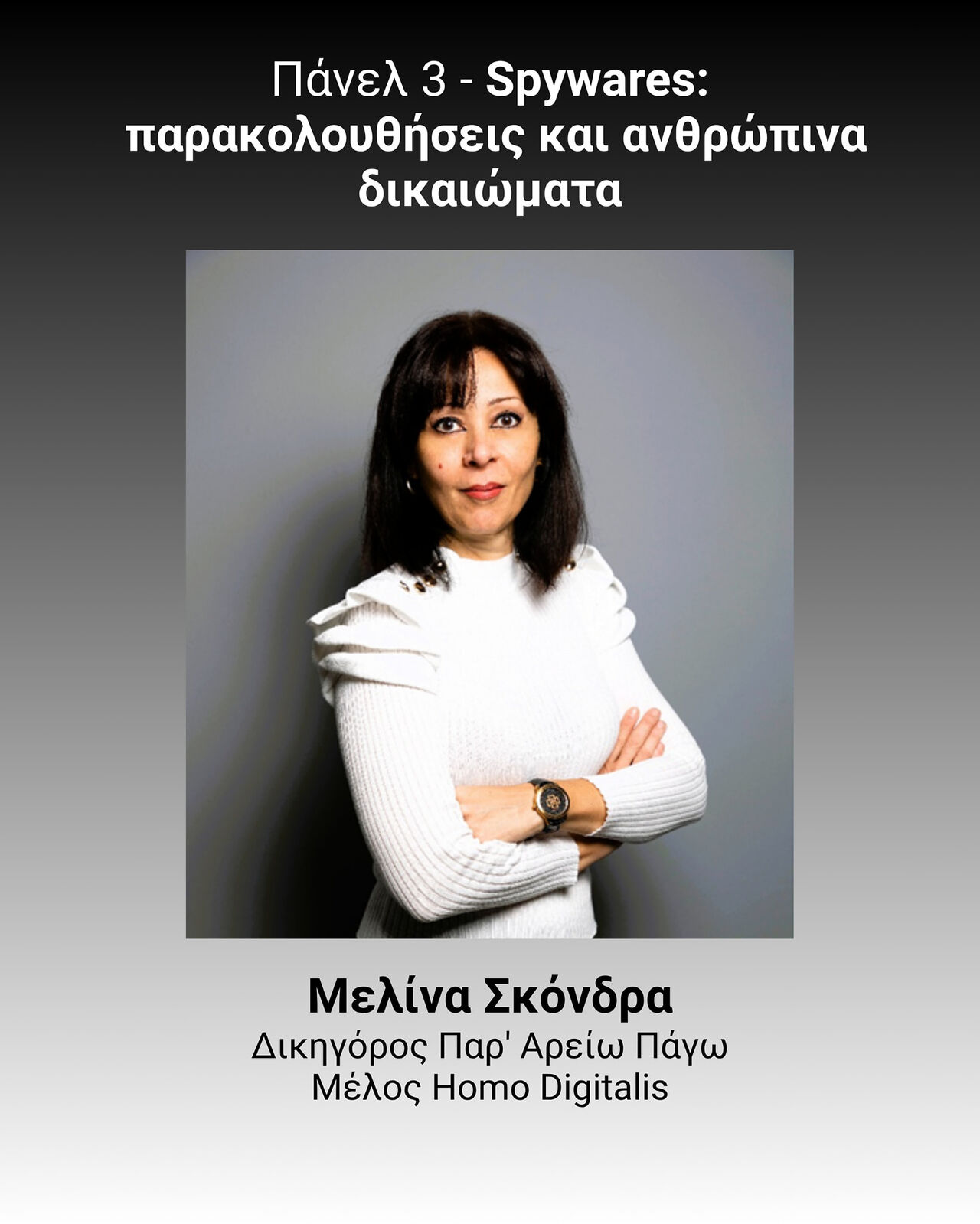
Participation of Homo Digitalis in a Conference on Spyware
On Friday, November 21, Homo Digitalis was represented by our member and Lawyer admitted to the Supreme Court, Melina Skondra, who delivered an outstanding contribution in the third panel of the conference “The Rule of Law Today in Greece and Europe,” on the topic: Spyware, surveillance, and human rights.
We had the honor of sharing the panel with Thanasis Koukakis, journalist and victim of surveillance, and Maria Alexandri, Lawyer admitted to the Supreme Court and member of the Research Group on Information Law at the University of Macedonia.
The conference was organized by DEMOTRUST with the support of the Friedrich-Ebert-Stiftung, under the auspices of the Centre for European Constitutional Law and syntagmawatch.gr, with ROSA MEDIA as the media sponsor.
We thank the organizers for their kind and honorable invitation!

Press Release on today’s announcement of the Digital Omnibus packages:
The proposed provisions of the Digital Omnibus were made public today, placing our rights and the safeguards protecting us in the digital environment at serious risk.
These new proposed regulations threaten the core of the European data protection framework and a range of other digital rights, directly affecting key instruments such as the GDPR, the ePrivacy Directive, and the AI Act.
The European Commission’s broader deregulation agenda primarily serves the interests of large technology companies, sidelining fundamental rights. Through these choices, the European Commission is effectively deviating from its mission and failing to fulfil its institutional responsibility.
We call on the Council of the European Union and the European Parliament to reject this attempt to dismantle the European framework for Digital Rights, and instead to focus on the consistent and effective enforcement of the rules that are already in place.
Read our full press release here.