
Homo Digitalis on PARAPOLITICA 90,1 FM radio
On June 26 2019, Homo Digitalis’s Katerina Pouliou, had an interview on PARAPOLITICA 90,1 FM radio with the journalist G. Houdalakis from “Noris” (Early) radio broadcast and discussed the currently interesting issues arisen from elections and the processing of personal data!
You can now listen to the interview on our YouTube channel here (in Greek).


The GDPR is applicable to all
Written by Konstantinos Kakavoulis
At the end of May, the Belgian Authority for the Protection of Personal Data [“L’Autorité de protection des données” (APD)] imposed a fine for violating the provisions of the General Data Protection Regulation (“GDPR”) for the first time.
You want probably to stop reading this article. If you hear the amount of the fine, you will probably stop immediately: just 2.000 euros.
However, this decision is very interesting. That’s because the Belgian Personal Data Protection Authority imposed this fine on a mayor!
The mayor had sent 2 emails to two city residents about his campaign. The two citizens had sent firstly e-mail to the mayor, in which they analyzed their idea of a project in their city. The mayor one day before the local elections responded to the emails of the two citizens by sending them his political campaign.
The Belgian Authority considered that the use of the e-mail addresses of the two citizens was abusive and imposed a fine.
“Public officials are the first to comply with the law. A mayor is expected and must know the legislation and comply with it.”
As noted by Hielke Hijmans, the President of the Belgian Authority, “the use of personal data by politicians for electoral purposes is an important issue for citizens. Public servants are the first to comply with the law. A mayor is expected and must know the legislation and comply with it. “
Personal data “are collected for specified, explicit and legitimate purposes and are not further processed in a manner incompatible with these purposes” (Article 5 (b) GDPR).
In this case, the mayor had received the email addresses of the two citizens for a very specific purpose. But he chose to use them for a completely different purpose. This behavior is a violation of the GDPR. Indeed, it is particularly interesting that the Belgian Authority has focused its attention on the provisions of the GDPR and not on national legislation on electronic communications.
So what did the Belgian authorities say with this decision?
That privacy is everyone’s responsibility!
The obligation to protect and correctly process personal data is not only for companies and organizations. Public servants and public officials also have a serious responsibility. They must realize that personal data that they have gathered in the exercise of public authority can not in any way be used for personal gain.
Clearly, we already knew from the scope of the GDPR that public officials also have to comply with the rules. However, this is the first time that a national authority enforces it in practice.
As the national elections are approaching at our country and we still have memories of pre-electoral messages from candidates in the municipal elections and the European elections, we expect to see if the candidates will take into account the personal data of the citizens as a worth-protecting element.
In any case, if you feel that your personal data are being violated by candidates in the upcoming elections, you can file a direct and free complaint with the Greek Data Protection Authority. In fact, the Greek Authority has recently published its decision on a similar case in which it imposed a fine of 2,000 euros to a candidate for a Member of the European Parliament.

Homo Digitalis at the 4th Data Privacy & Protection Conference
On the 25th of June 2019, Homo Digitalis had the great pleasure to participate as a scientific partner at the 4th Data Privacy & Protection Conference.
One year after the enforcement of GDPR at national and European level, the 4th Data Privacy & Protection Conference noted the changes and new rules that have emerged.
Homo Digitalis participated both as member of the conference organizing committee and as speaker. Our organization’s Vice-President, Mr. Stefanos Vitoratos represented it, who analyzed the protection of personal data as a form of social corporate responsibility and as leverage to boost the reputation and businesses’ profits.
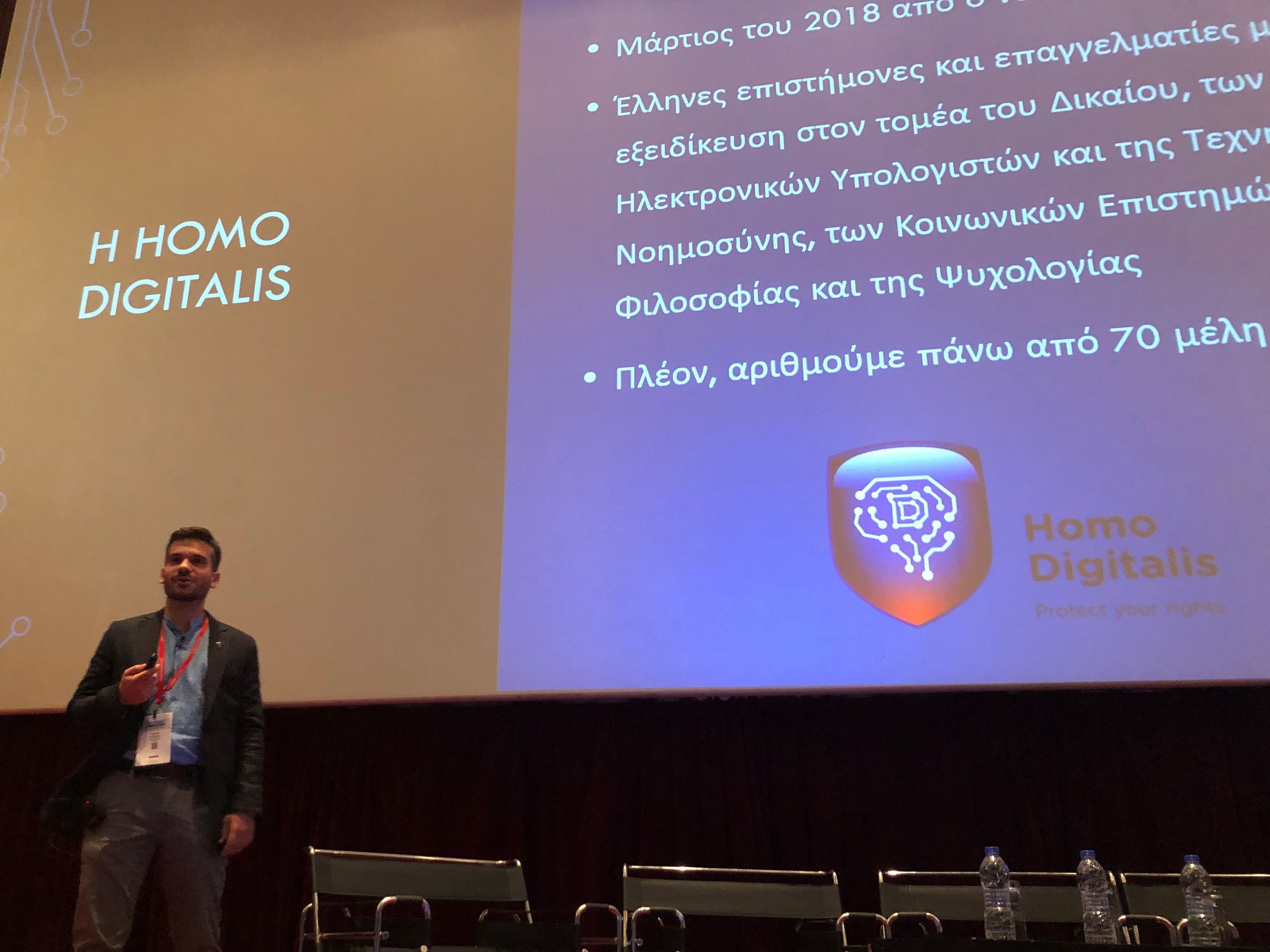
Mr. Stefanos Vitoratos during his speech at the 4th Data Privacy & Protection Conference
More than 40 reputable speakers from Greece and abroad participated in the conference and exchanged significant experiences of how to exploit the power of data through responsible use, economic growth and social benefits.
It was a great honor for Homo Digitalis to be among the most respected professionals and academics who are involved in the field of privacy and the protection of personal data.
The following members of our organization attended the conference: Ms. Elpida Vamvaka, Mr. Konstantinos Kavavoulis, Mr. Emmanouil Mandrakis, Ms. Maria-Alexandra Papoutsi, Mr. Emmanouil Tzivieris, Mr. Vassilis Vassilopoulos, Ms. Athena Mavridou, Mr. Michalis Drakoulakis and Mr. Dimitris Patsos.
We would like to thank Ms. Stella Tsitsoula and Boussias Communications for the excellent co-organization!

The newest issue of GDPR Today is out!
The newest issue of GDPR Today is out!
Today, June 11th 2019, the new issue of GDPR Today has been released including many articles and statistics about the compliance of GDPR!
Read first the latest news at a Member-State/ EU level that concern the GDPR provisions’ implementation, one year after its enforcement!
Moreover, the “GDPR in numbers” section provides statistical information with great interest concerning Data Protection Authorities by 14 Member States, including these of Greece and Cyprus!
At this point, we would like to whoheartedly thank the Office of the Commissioner for Personal Data of Cyprus and the Hellenic Data Protection Authority for their in full and excellent cooperation and for sharing the necessary statistical data, once again!
This issue has been edited by the organisation European Digital Rights.
Homo Digitalis participated in the issue together with the following organisations:
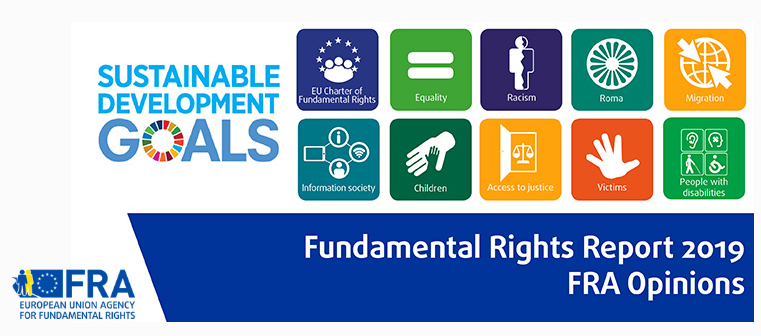
FRA's new Annual Report on Human Rights and its new research on Artificial Intelligence is here!
The European Union Agency for Fundamental Rights (‘FRA’) published its new report on Human Rights on June 6.
The report summarizes and analyzes the most significant developments in the field of Human Rights in 2018 in the European Union and includes specific proposals and suggestions for action.
One of the most important pillars of the report that is of particular interest is Chapter Seven (7), which specifically is related to information society and privacy and personal data protection issues.
In this year’s edition of the report, Chapter Seven focuses on the implementation of the GDPR provisions, on developments in artificial intelligence and cyber-security, on case-law/legislation developments on the preservation of electronic communications metadata, and on cross-border access to data related to law enforcement authorities.
The report also includes chapters related to: the EU Charter of Fundamental Rights and its use by the Member States, equality and non-discrimination, racism, xenophobia and related forms of intolerance, Roma inclusion, asylum, borders and immigration, children’s rights, access to justice and the implementation of the UN Convention on the rights of the people with disabilities.
On June 11, FRA published its new study on Artificial Intelligence. The study focuses on the importance of data quality used by mechanical learning algorithms for automated decision making.

Homo Digitalis to the organizing committee of the Data Privacy & Protection Conference 2019
Homo Digitalis has the great pleasure and honour to participate in the organizing committee of the 4th Data Privacy & Protection Conference! Our Vice President, Stefanos Vitoratos, is actively involved in organizing the Conference together with the well-known executives and renowned professionals in the field of personal data protection and privacy.
The event takes place on Tuesday 25th of June 2019 in Maroussi of Attica Region, and is the annual leading DPOs conference in Greece!
At this conference, speakers from our country and abroad will share and exchange their experiences and further elaborate in the level of compliance of Greek and EU organisations and will advise on the proactive actions required to fulfill better level of compliance with GDPR! The conference also will focus on modern technologies and global developments in the issues of personal data security.
You can see the full program of the 4th Data Privacy & Protection Conference and the speakers here.
Registrations are open and Homo Digitalis members could register with a special discount voucher!
We want to wholeheartedly thank the rest members of the Organizing Committee for the excellent cooperation and Boussias Communications for the excellently detailed preparation of the event.

Homo Digitalis at ENISA Conference in Greece
At the beginning of this week, our organisation had the great pleasure and honour to participate in the conference organised by the European Network and Information Security Agency (“ENISA”), under the title: “Artificial intelligence: An opportunity for the EU cyber-crisis management”.
At this conference, we had the pleasure to exchange ideas and opinions with specialists from Greece and abroad, representatives of the institutions and bodies of the European Union, Academics and private operators.
You can see the full program of the Conference here.
We want to wholeheartedly thank the organisers of the Conference for this event, which was free of charge and of high level of quality. It is of paramount importance such actions to take place in Greece so as to enhance the dialogue between the involved stakeholders and to forge significant partnerships.

Who “plays” with your personal data?
Written by Anastasia Karagianni
Video games are source of fun for both children and adults. Most video game studies focus on their content, whether they motivate violence or whether they are neutral, or on the effects they have on the user’s/player’s psychology.
However, has anybody wondered who hides behind them and what he earns from the services offered to the players, which are usually free of charge?
Before 1986 for games such as ‘The Legend of Zelda’ in NES, and for the rest of the console games, it was difficult, even impossible, to store the data of their players.
Nowadays, video game developers use advanced computing methods such as Hadoop and MapR to collect, edit and analyze mass data (Big Data) [2] to better understand players’ behavior.
But what data can companies collect through their video games? The physical characteristics of a player, such as his facial features, body movement and voice data, location and information collected by the social networks to which the player is connected are some of them.
Some games, in fact, contain motion-sensing sensors such as the popular Nintendo Wii console and later Xbox Kinect.
Thus, companies collect the biometric data of the player, such as the weight and the features of his face, that are necessary to provide the services or, otherwise, to start the game.
For example, the Wii collected data about the player’s physical condition for the popular WiiFit exercise game [3].
Moreover, in addition to the above, the player’s social behavior is monitored by the decisions he takes during the game, such as his temper, his leadership, his fears and his political beliefs.
See for example the questions in the Catherine game. “Do you carefully choose which underwear you wear every day?” “Have you ever cheated on your partner?” Catherine is a video game developed by Atlus and concerns the love relationships and the moral dilemmas resulting from the commitment of comrades.
Vincent, the main character of the game, must decide whether to choose Katherine’s girlfriend or charming girl Catherine. The game was released by Atlus for PlayStation 3 and Xbox 360 in Japan and North America in 2011, while for Microsoft Windows it will be released by Sega in 2019.
In addition, players need some video games to buy their products, as in Fortnite. In this way, companies know and store the credit card or bank account details that make the payment. All of this data is used by companies to record who uses their products and how they can promote them.
Already since 2005 with the release of Xbox 360 video games have been linked to players watching. According to Stéphanie Perotti, Ubisoft uses its customer data mainly for marketing purposes and for demographic studies, that are designed to continually improve the products and services they offer to ensure that they meet customer expectations.
Except for marketing reasons, however, companies can actually improve the games they produce based on their users’ data. The developer of the successful Candy Crush series has found that many users have left the game at level 65. Thus, he has made Level 65 easier so as for users to continue playing it.
So what can you do to prevent your personal data from being collected? You should be very careful when downloading a game or installing it.
In particular, check the application’s privacy policy, the terms of use and installation of the game, and whether you consent to the collection and processing of your personal data.
This is because most companies ask for access to your data. Would you like to play a video game, and the marketer would watch what exactly you are doing when you are in front of your computer or who else is in the same location with you?
Finally, we notice that video games have been part of the everyday life and culture of young people. It is worth pointing out that according to a study of nature human behavior, 94% of parents know that their children play video games, so that’s why they keep an eye on them while their children play. However, the reactions about video games vary.
Speaking of the reactions and criticisms that have been arisen about the video game culture, it is worth mentioning the #Gamergate. In more detail, #GamerGate is an online movement that began mainly on social media, on Twitter and on Facebook in August 2014 due to a publication by Eron Gjoni on a blog.
In particular, Eron revealed the secret relationship of his former partner, Zoe Quinn, with Kotaku’s author in order to write a positive critique of the game of Depression Quest.
Following the negative reviews published by Eron, Zoe Quinn received death threats via email, and also her accounts on Tumblr, Dropbox, and Skype were hacked. Brianna Wu, who also spoke negatively about #Gamergate supporters received threats of rape and death threats.
In a nutshell, if we have to propose one course of action for the problem of privacy and personal data protection, it is certainly not a gaming ban but instead prior protection and detailed information.
For this reason, the next time you want to play, check out in advance … who is playing with whom!
- [1] https://saferinternet4kids.gr/press-newsletter/press/fortnite-2/.
- [2] Marios M. Giakalaras,Christos P. Tsongidis, Posthuman:Biometrics, Big Data and Videogames,Department of Cultural Technology and Communication, University Of Aegean.
- [3] Alexander Dean Cybulski, Enclosures at Play: Surveillance in the Code and Culture of Videogames.
- [4] http://www.theesa.com/wp-content/uploads/2017/09/EF2017_Design_FinalDigital.pdf.
- [5] Stephen R. Mallory, Cultivating GamerGate.
Complaint lodged by Homo Digitalis against Greece for non-compliance with the EU’s data privacy law addressed to the European Commission
Today, on 30.05.2019, our organisation lodged a complaint (reference number CHAP201901564) before the European Commission against Greece for non-compliance with the EU law on the protection of personal data (Directive 2016/680 and GDPR).
The complaint is related to Directive 2016/680, which regulates the processing of personal data by the national law enforcement authorities for the purposes of prevention, investigation, detection or prosecution of criminal offences or the execution of criminal penalties. According to article 63 of this Directive, Member States shall adopt and publish, by 6 May 2018, the laws, regulations and administrative provisions necessary to comply with this Directive. They shall forthwith notify to the Commission the text of those provisions.
However, Greece has not transposed and adopted such law provisions yet, one year and twenty four days after the end of this deadline. Therefore, Greece breaches the mentioned Article 63
The provisions of the Directive 2016/680 are of the utmost importance for the protection of Democracy and the Rule of Law, as they provide a high level of protection for data subject’s rights against the processing of such data by the police or other national law enforcement authorities. This Directive replaces a very poor legal framework, the Council Framework Decision 2008/977/JHA, which unfortunately had an extremely limited scope (cross-border data exchange between the law enforcement authorities of Member States) and was not striking the right balance between law enforcement authorities’ needs in the course of their investigations and the rights of the people that are at the center of these investigations. As a result the legal principles around the processing of personal data were not respected and data subjects’ rights were noticeably weakened.
Thereby, for the first time, a single European framework that regulates the way the policeman of the neighbouring department, the border guard etc. can process our personal data and clearly provides how we shall exercise our rights to the police or other law enforcement authorities. You can find further information on the Directive 2016/680 here.
Greece by delaying the proceedings of such legislation and the adoption of the necessary provisions at a Member State level deprive data subjects and Greeks from their rights, as enshrined in the paragraphs 12-18 of the Directive, while creates concerns about citizens’ trust in the ways the law enforcement authorities treat their personal data. Specifically, the non transposition of the provisions concerning data protection by design or by default, the non keeping of the records of processing activities, etc. decrease public’s trust concerning the lawful processing of their personal data operated by these authorities.
Furthermore, the complaint raises issues related to the Regulation 2016/679 (GDPR). Specifically, our organisation highlights that despite the fact that GDPR shall be binding in its entirety and directly applicable in all member states, by 25.05.208, the European legislator has transferred important issues at the discretion of Greek legislator. These latter issues are related to the i.e. the minimum age for child’s consent in relation to information society services (article 8), provision for further conditions and restrictions on the processing of genetic and biometric data or data concerning health (article 9), NGO’s right independently of any data subject’s award to lodge a complaint and exercise the rights referred to articles 78 and 79 GDPR (Article 80), penalties for infringements which are not subject to administrative fines (Article 84), the processing of employees’ personal data in the course of their employment (Article 88), and obligations concerning confidentiality (Article 90).
Therefore, Greece without having up to date – one year and five days after the enforcement of GDPR– draft law, creates uncertainty to data subjects and Greeks with regard to the protection of their rights and confusion about the specific issues as mentioned above which are in need of direct implementation.
European Commission will process our complaint within the period of twelve months and will inform us οn its progress.
You can find the proof of our submitted complaint and its full text here. Finally, you can see our organisation’s press release here.