

Homo Digitalis speaks on ERTnews
On Thursday, December 11, Homo Digitalis had the great pleasure of being a guest on the ERTnews program “LIVE NOW”, hosted by Giorgos Kakousis and Nikoleta Kritikou, to discuss the upcoming revisions to the U.S. visa waiver program, ESTA.
The proposed changes foresee the collection of more—and particularly sensitive—personal data, including biometric data, email accounts from the past 10 years, and social media accounts from the past 5 years, among other information.
The plan of the U.S. government is to complete the agreement procedures with the various countries participating in the ESTA visa waiver program by December 2026, so that the new rules can begin to apply from the following year.
The European Union has already, since the summer, initiated the required institutional procedures in order to negotiate at EU level with the United States the framework for the exchange and processing of the relevant data. This framework is expected to form the basis of a comprehensive agreement between the EU and the U.S., upon which Member States, such as Greece, will subsequently be called to conclude the necessary bilateral agreements for the implementation of the new ESTA regime.
In the field of personal data protection, the European Data Protection Supervisor has already issued a relevant opinion on the matter since September. This opinion focuses primarily on the exchange of biometric data, as well as on the necessary safeguards of security, oversight, and accountability that must accompany their processing.
Homo Digitalis was represented on the program by our Executive Director, Lefteris Chelioudakis. We warmly thank ERTnews for the invitation! You can watch the relevant segment here (from 47:00 onwards) here.


Press Release on today’s announcement of the Digital Omnibus packages:
The proposed provisions of the Digital Omnibus were made public today, placing our rights and the safeguards protecting us in the digital environment at serious risk.
These new proposed regulations threaten the core of the European data protection framework and a range of other digital rights, directly affecting key instruments such as the GDPR, the ePrivacy Directive, and the AI Act.
The European Commission’s broader deregulation agenda primarily serves the interests of large technology companies, sidelining fundamental rights. Through these choices, the European Commission is effectively deviating from its mission and failing to fulfil its institutional responsibility.
We call on the Council of the European Union and the European Parliament to reject this attempt to dismantle the European framework for Digital Rights, and instead to focus on the consistent and effective enforcement of the rules that are already in place.
Read our full press release here.
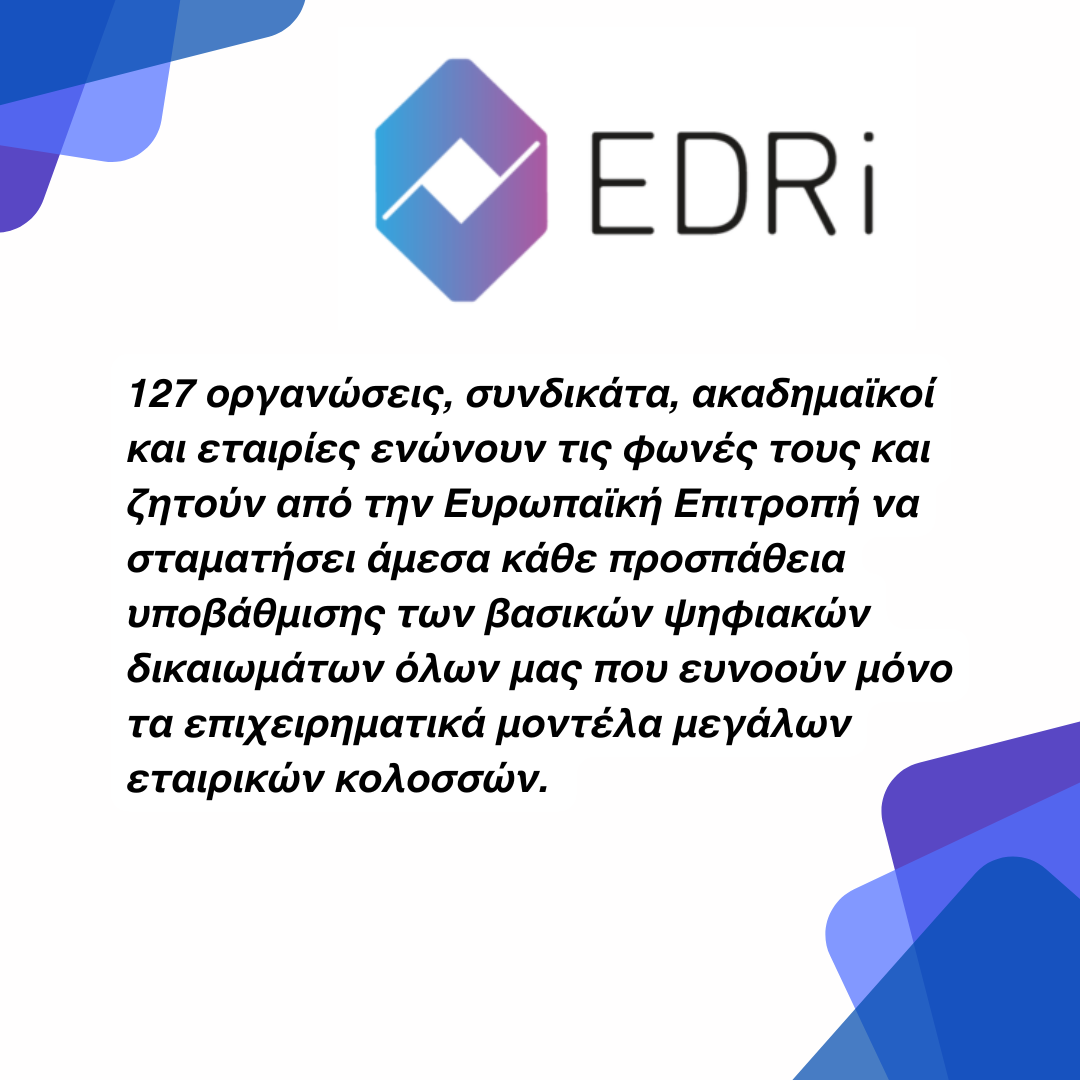
Joint Open Letter on the Digital Omnibus Packages to the European Commission
On Wednesday, 19 November, the European Commission will present the new “Digital Omnibus,” a reform that threatens to dismantle fundamental protections of our rights and freedoms in the digital sphere.
In May and October 2025, we warned through open letters that this initiative is part of a broader wave of deregulation that will weaken key European rules, portraying rights as an obstacle to innovation and serving the interests of major technology companies.
A few days ago, leaked draft documents confirmed our fears: the EU is one step away from the largest rollback in the protection of human rights in the digital space. The GDPR, ePrivacy, and even the already weak provisions of the AI Act appear to be targeted for dilution, along with other related legislation.
Together with European Digital Rights, 127 organizations, trade unions, academics, and companies are joining their voices and calling on the European Commission to immediately halt any attempt to undermine our fundamental digital rights—efforts that benefit only the business models of large corporate giants.
Read our letter here.

Participation of Homo Digitalis in a Working Group of the European Commission’s AI Office
We’re excited to share that last week Homo Digitalis, represented by our member Tania Skrapaliori, participated in the European Commission’s AI Office Kick-off Plenary for the drafting of the Code of Practice on Transparency of AI-Generated Content (Article 50 AI Act).
We are eager to participate in the respective working groups and actively contribute to this process
During the session, participants heard from the AI Office, met the Chairs and Vice-Chairs responsible for drafting the Code, and learn about insights gathered through the recent multi-stakeholder consultation on transparency requirement
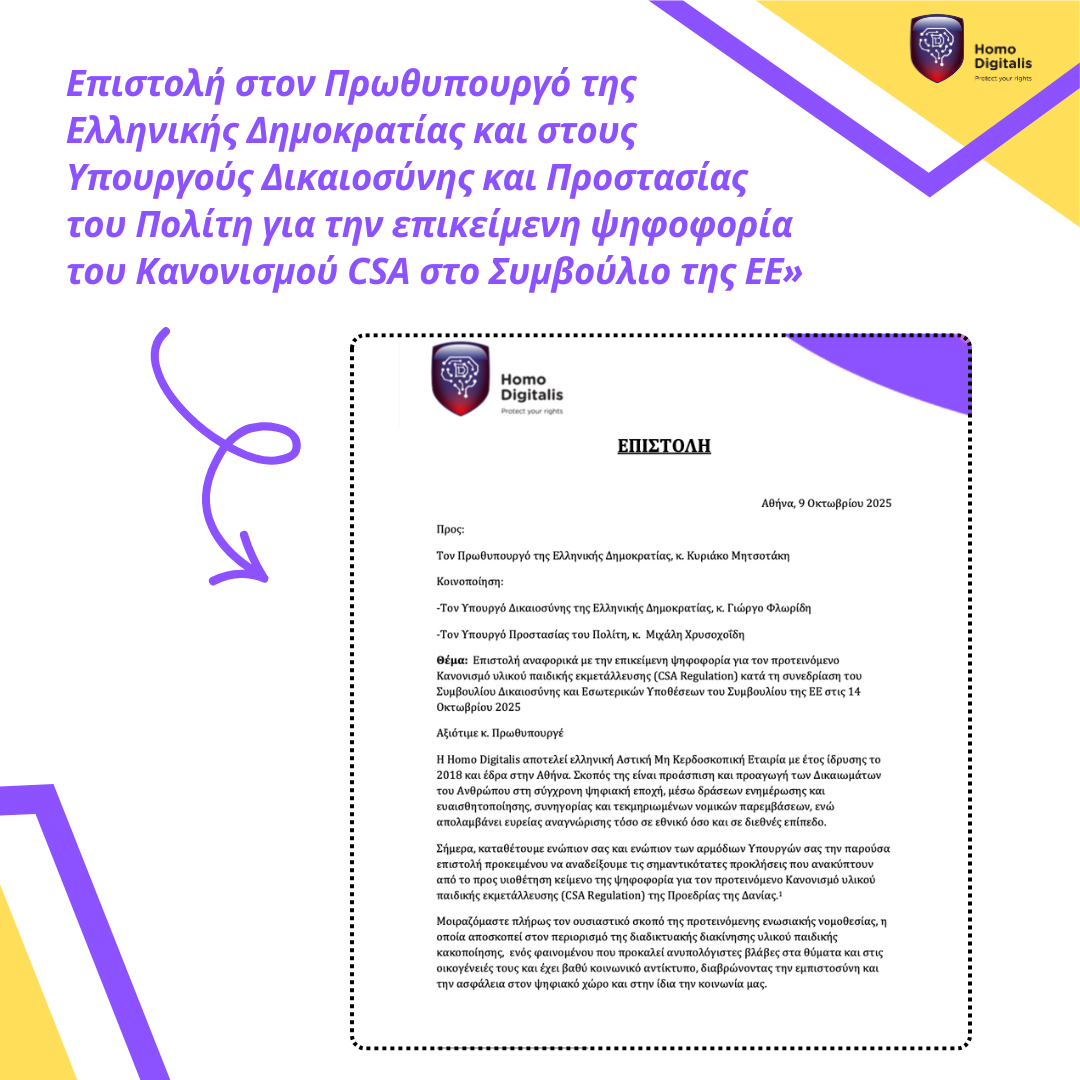
We submit an Open Letter to the Prime Minister, calling on the Hellenic Republic to reject the Danish Presidency’s text on the CSA.
Homo Digitalis today submitted an Open Letter to the Prime Minister of the Hellenic Republic, Kyriakos Mitsotakis, regarding the proposed Regulation on Child Sexual Abuse Material (CSA Regulation).
In our letter — which we have also shared with the Minister of Justice and the Minister for Citizen Protection — we call on the Hellenic Republic to reject the Danish Presidency’s text in the upcoming vote at the EU Justice and Home Affairs Council on October 14, 2025.
The objective of the Regulation — to curb the distribution of child sexual abuse material — is right and necessary. However, the text proposed by the Danish Presidency would achieve the opposite effect, undermining security and trust in the digital space.
Specifically, 787 leading experts in communication security and encryption — including professors from top academic institutions in Greece — have emphasized that:
The technology for detecting child sexual abuse material is inaccurate and ineffective.
Mandatory scanning undermines end-to-end encryption and opens the door to mass surveillance.
The proposed technical measures can be easily bypassed by malicious users and threaten anonymity and freedom of information.
Real child protection comes through education and support for victims, not through mass monitoring.
On October 14, Greece’s position must be guided by knowledge, technical expertise, and the fundamental principles and values upheld by the EU Charter of Fundamental Rights and the Constitution of Greece.
You can read the full text of our open letter here.
You can also read a related article recently published on our website by our member Stergios Konstantinou here.
Learn more about Homo Digitalis’s work on this issue, including past meetings between our members — Haris Kyritsis, Haris Daftsios, Niki Georgakopoulou, Giorgos Sarris, and Angelina Barla — and Greek Members of the European Parliament, in cooperation with European Digital Rights (EDRi), here.

We submitted our views to the European Commission’s public consultation on Article 30(5) GDPR
Yesterday, Homo Digitalis submitted its views as part of the European Commission’s public consultation on Article 30(5) of the GDPR.
In our submission, we call on the Commission to withdraw the proposed amendment and stress the need to ensure that the GDPR is not reopened or modified through broader deregulatory initiatives. The priority must remain on the effective application and enforcement of the existing framework, rather than on reducing the safeguards that are essential for protecting fundamental rights in the digital age.
You can read our full position here.

We filed a complaint against Alphabet before the European Commission under the provisions of the DMA, together with five organizations.
European Digital Rights, ARTICLE 19, Free Software Foundation Europe (FSFE), Gesellschaft für Freiheitsrechte e.V., Vrijschrift.org, and Homo Digitalis filed a formal complaint against Alphabet Inc. under the Digital Markets Act (DMA) before the European Commission.
Despite the DMA’s clear gatekeeper rules:
On Android, users still cannot truly uninstall Google’s pre-installed apps; they can only disable them, which leaves them on the device. Yet Alphabet misleads users by claiming this is the same as removing an app. It is not.
The disable option is buried deep in the settings and, when users do find it, Android displays vague and intimidating warnings that discourage them from switching to alternative apps, making it harder to move away from Google’s ecosystem.
We are facing a textbook case of deceptive design, which restricts user choice and reinforces Alphabet’s gatekeeper position.
With our complaint, we call on the European Commission to investigate Alphabet’s practices and order the company to fully respect end-user rights under the DMA.
You can read our complaint on EDRi’s website here.

Homo Digitalis contributes to two EU consultations on the Data Strategy and high-risk AI systems
Last Friday, July 18th, Homo Digitalis submitted detailed input to two public consultations launched by the European Commission.
The first consultation focused on collecting targeted input from stakeholders regarding the implementation of the AI Act (2024/1689) rules for high-risk AI systems. According to Article 6(5) of the AI Act, the Commission must publish guidelines on the practical implementation of the high-risk classification rules by February 2, 2026, accompanied by a list of practical examples of both high-risk and non-high-risk AI systems. Additionally, Article 96(1)(a) requires the Commission to provide guidelines on the application of obligations and responsibilities for high-risk AI systems, including those across the AI value chain, as defined in Article 25. In its submission, Homo Digitalis provided practical examples of AI systems from Greece and other countries, and highlighted key issues that should be clarified in both the classification and compliance guidelines.
The second consultation addressed the EU Data Strategy. Its three goals are to: 1) boost investment in data technologies and promote data sharing through voluntary or funded initiatives; 2) streamline existing rules and develop data tools to reduce administrative burdens; and 3) shape an international data strategy that ensures safeguards for data transfers outside the EU and encourages data inflows into the EU.
In its response, Homo Digitalis raised strong concerns about potential undermining of personal data protection under the pretext of simplification, flexibility, and competitiveness. The organisation reaffirmed its position that fundamental rights must be strengthened through the use of new technologies and rejected the framing of existing legal frameworks as a barrier to innovation. According to Homo Digitalis, the challenges lie primarily in the lack of enforcement and resources, not the laws themselves.
You can read our full submission for the first consultation here.
We thank the drafting team, Stavrina Chousou, Niki Georgakopoulou, Sofia Antonopoulou, and Eleftherios Chelioudakis, for their valuable contributions.
You can read our full submission for the second consultation here, edited by our Executive Director, Eleftherios Chelioudakis.