
Following our complaint, the Hellenic Data Protection Authority has launched an investigation into the Ministry of the Interior.
The Ministry of the Interior under scrutiny by the Data Protection Authority! Was the use of Artificial Intelligence in the evaluation of civil servants lawful?
Following a complaint and a request submitted by Homo Digitalis, the Hellenic Data Protection Authority has officially launched an investigation into the use of Artificial Intelligence by the Ministry of the Interior in the evaluation of civil servants.
Through 11 specific questions, the Authority is examining how Artificial Intelligence was used, how civil servants’ personal data were handled, and whether the fundamental principles and relevant legal obligations under the applicable legislation were respected.
The Ministry of the Interior has been asked to provide explanations within 30 days of receiving the Authority’s letter.
Find out more about the case and read the Authority’s official letter here.


What happened with the use of AI in the evaluation of public sector employees?
On November 4, Homo Digitalis took two complementary actions before the Hellenic Data Protection Authority (HDPA) regarding the use of Artificial Intelligence by the Ministry of the Interior in the evaluation of public sector employees.
1st intervention: We are representing a public sector employee in a complaint filed with the HDPA, requesting an investigation into how the Ministry responded to her request for access to her personal data, as well as broader issues concerning compliance with the General Data Protection Regulation (GDPR).
2nd intervention: We are calling on the HDPA to investigate the matter on its own initiative, as the use of AI may affect thousands of public sector employees who may not have been adequately informed.
We recall that, as early as July 2026, together with the Institute for Research on Regulatory Policies and the public sector employee concerned, we had also filed a complaint with the National Transparency Authority, requesting an investigation into compliance with transparency obligations and the requirements for an algorithmic impact assessment. The complaint is currently under investigation.
Artificial Intelligence in the public sector must not operate without transparency, accountability, and respect for workers’ rights! We will continue to call for meaningful oversight and the protection of everyone’s personal data.

Following a complaint we filed, the Hellenic Data Protection Authority (HDPA) has launched an investigation into the National Intelligence Service
The Hellenic Data Protection Authority launches an investigation into the National Intelligence Service (EYP), following a complaint filed by us!
As early as 1997, data protection legislation did not exempt the National Intelligence Service (EYP) from the Authority’s supervisory oversight. Furthermore, the EYP’s internal regulations have required the Service to comply with personal data protection legislation since 2008. However, in 2019, the Mitsotakis government, through Law 4624/2019, restricted the Authority’s competence to oversee the processing of classified personal data by the EYP.
In November 2022, the HDPA itself, in an opinion submitted to the Ministry of Justice, highlighted serious concerns regarding the constitutionality of the legal framework and the effective protection of personal data processed by the EYP. The Authority’s recommendations were not incorporated into the revision of the legislative framework in December 2022 by the then Minister of Justice, Konstantinos Tsiaras.
In March 2026, a citizen represented by our organisation attempted to exercise their personal data protection rights before the EYP by submitting an access request, invoking specific provisions of the law. The EYP failed to respond to the request. As a result, in June 2026, we filed a formal complaint with the Authority.
In October, we were informed that the Authority had launched an investigation into our complaint, requesting that the EYP respond to specific questions concerning its failure to address the citizen’s access request. This is an important development in our efforts to clarify the EYP’s obligations and establish the extent to which the processing of personal data by the Service is subject to independent oversight.
The crucial question remains: How can the protection of personal data be guaranteed in practice when such data is in the hands of the National Intelligence Service?
National security and the protection of fundamental rights must go hand in hand, supported by clear rules, meaningful safeguards, and effective oversight.

Our Complaints Over the Unlawful Retention of Biometric Data Have Been Pending for Six Years
Do you have a passport?
Then the Hellenic Police has also unlawfully stored your biometric data in a central database!
High-resolution facial photographs, such as those required for our passports, are considered biometric data. Their processing, however, is subject to strict rules.
European Union law provides that the photograph must be stored on the microchip embedded in the passport itself. The Court of Justice of the European Union has ruled that, if a Member State wishes to retain these photographs in a central database as well, there must be a clear national law explicitly providing for this.
The Hellenic Police maintains that Article 9 of Presidential Decree 178/2014 provides this legal basis. We disagree. This provision refers only to the maintenance of an electronic register of passports and statistical data, and does not explicitly provide for the storage of biometric data.
In June 2020, Homo Digitalis represented two citizens and lodged complaints with the Hellenic Data Protection Authority (HDPA).
In January 2026, we were informed by the HDPA that the cases were still pending. More than six years have passed since the complaints were filed.

Homo Digitalis Files a Complaint Against the National Intelligence Service
In August 2019, with the adoption of Article 10 of Law 4624/2019, the Greek Government introduced a significant legislative change that restricted the framework for personal data protection in Greece.
As a result of this amendment, the Hellenic Data Protection Authority (HDPA) lost its competence to supervise the processing of classified personal data by the National Intelligence Service (EYP).
In its 2022 Opinion, the HDPA highlighted that: “Questions arise as to the legality and constitutionality of this provision in light of Article 9A of the Greek Constitution and Convention 108, since, in essence, no personal data protection is provided when any activity involving the processing of personal data is carried out by the EYP.”
Nevertheless, the Greek Government failed to take these concerns into consideration.
In March 2026, a citizen attempted to exercise their personal data protection rights before the EYP. However, despite repeated communications, they received no response.
In June 2026, Homo Digitalis represented the data subject and filed a formal complaint with the Hellenic Data Protection Authority (HDPA) on their behalf.
The complaint calls for an investigation into whether the EYP has breached its legal obligations, clarification of the scope of the HDPA’s supervisory powers, and an examination of whether the EYP’s complete exemption from the oversight of an independent authority is compatible with Article 9A of the Greek Constitution and Greece’s international treaty obligations.
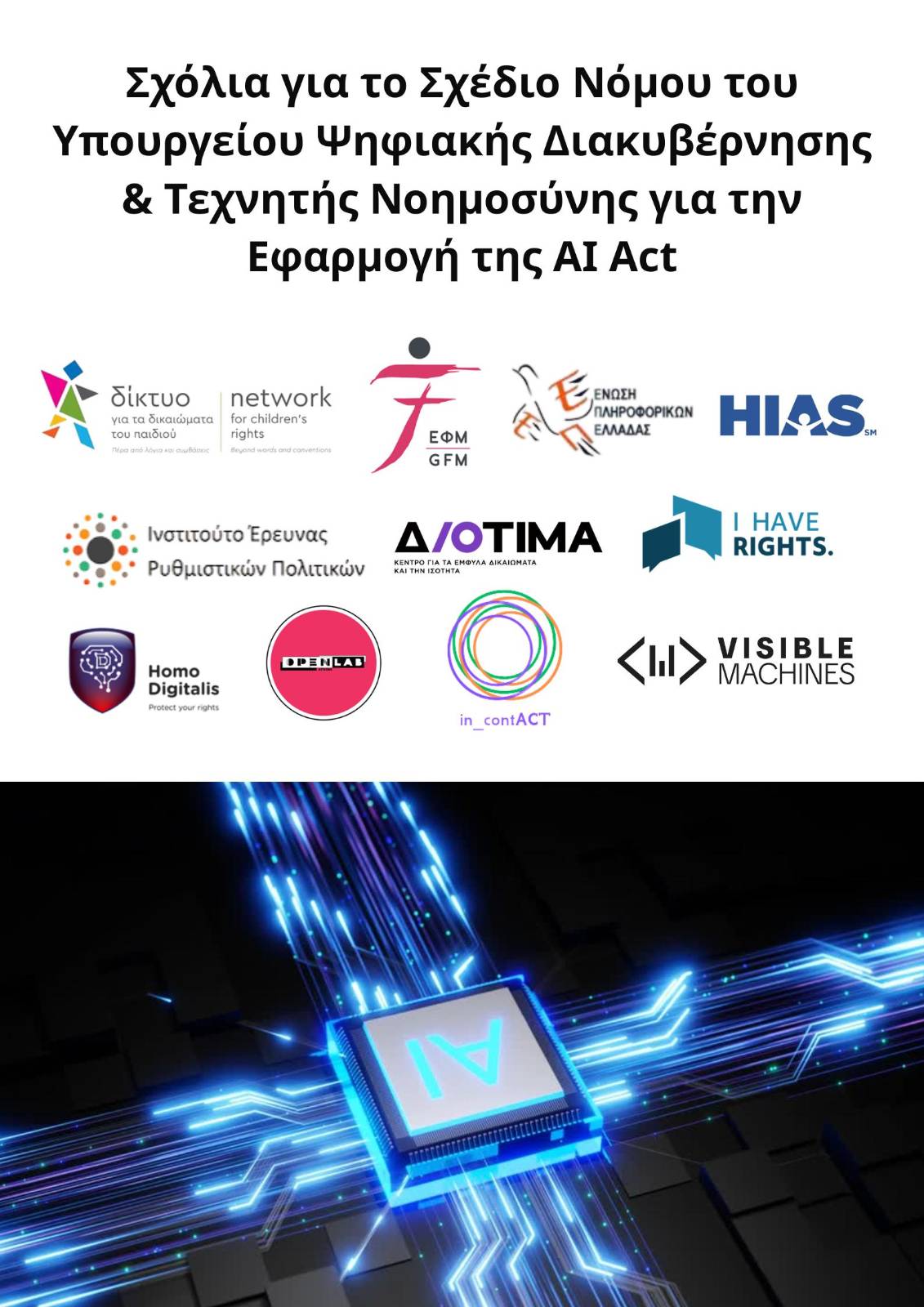
11 Civil Society Organizations Submit Joint Recommendations on the Implementation of the AI Act in Greece
Following their participation in the public consultation launched by the Hellenic Ministry of Digital Governance and Artificial Intelligence on the draft law implementing the AI Act in Greece, 11 civil society organizations have submitted a joint letter to the Special Secretariat for Artificial Intelligence & Data Governance, setting out their recommendations for improving the draft legislation.
Among other issues, the organizations highlight the need to substantially strengthen the Hellenic Data Protection Authority, so that it can effectively fulfill the critical supervisory role assigned to it. Similar concerns have also been raised by the Authority itself in its recent Opinion on the draft law.
Furthermore, making use of the discretion granted to Member States under the European Regulation, we call on Greece to introduce a complete ban on real-time remote biometric identification for law enforcement purposes. The exceptions provided for under the Regulation pose serious risks to fundamental rights and could lead to disproportionate surveillance practices.
We propose a similar approach to the use of comparable technologies for post-event identification, which is currently classified as a high-risk application.
You can read here at the link below, as well as on the public consultation webpage.
The 11 organizations in alphabetical order:
-Network For Children’s Rights
– Greek Forum of Migrants
– Hellenic Informatics Union
– INERP – Institute for Regulatory Policy Research
-Diotima Centre
-HIAS Greece
-Homo Digitalis
-I Have Rights.
-Ιn contACT
-Open Lab Athens
-Visible Machines (VM)
We filed a complaint against the National Technical University of Athens over the use of cameras!
The National Technical University of Athens features the mythical hero Prometheus in its logo, symbolizing forethought and prudence before action. However, in the case of the cameras, it appears that the institution itself did not demonstrate the foresight that Prometheus represents.
Specifically, noting that there does not appear to be a legal basis allowing the university to operate cameras, and given that the institution itself does not clearly specify in its Data Protection Policy which legal basis it relies on, we submitted an access request on January 13 in order to obtain the answers we are entitled to receive.
The deadline to receive a response passed, and despite our polite reminder, no one responded to our request. Therefore, yesterday we proceeded to file a complaint before the Hellenic Data Protection Authority. You can read more in our Press Release here.
The complaint follows joint actions with the organizations Reporters United and Vouliwatch, within the framework of which a joint request had already been submitted, since September 2025, before the HDPA for the exercise of its investigative powers.
In fact, following a related journalistic report that highlighted these actions in December 2025, the National Technical University of Athens sent an extrajudicial notice to journalist Dafni Karavola of Reporters United in February 2026. You can read more at the new report by Reporters United here.