
Letter from Homo Digitalis before NCRTV on the obligations arising from Regulation 2024/1083
On September 3, Homo Digitalis submitted an open letter (no. 4844-3-9-24) to the The National Council for Radio and Television (NCRTV), in which it raised two (2) questions regarding the application of the provisions of Article 25 of Regulation 2024/1083 on the establishment of a common framework for media services in the internal market.
In particular, as stipulated in Article 25, par. 2-3, the competent independent authorities in the Member States shall monitor and submit an annual report on the allocation of public advertising expenditure to media service providers and online platform providers. Those annual reports shall be made publicly available in an easily accessible format and shall be based on the information made public on an annual basis by electronic and user-friendly means by public authorities or entities that have incurred public advertising expenditure.
This information shall include at least:
(a) the official names of the media service providers or online platform providers from which services have been purchased,
(b) where applicable, the official names of the business groups to which any media service providers or online platform providers belong; and
(c) the total annual amount spent and the annual amounts spent per media service provider or online platform provider.
In view of the above, Homo Digitalis submitted the following two (2) questions before the NCRTV:
1 ) Has the NCRTV proceeded with the publication of the relevant annual report for the year 2023 regarding the allocation of state advertising expenditure to media service providers and online platform providers? If the NCRTV does not have the relevant competence, before which body should we appeal?
2) Does the NCRTV know whether public authorities or entities which have incurred expenditure on state advertising have complied with their obligation to publish annually by electronic and user-friendly means the information detailed in Article 25(2) of Regulation 2024/1083? In what ways could we as civil society monitor the respective activities of public authorities/entities in order to assist you in your work and inform you of any shortcomings in their compliance?
We hope to receive an answer to our questions soon.

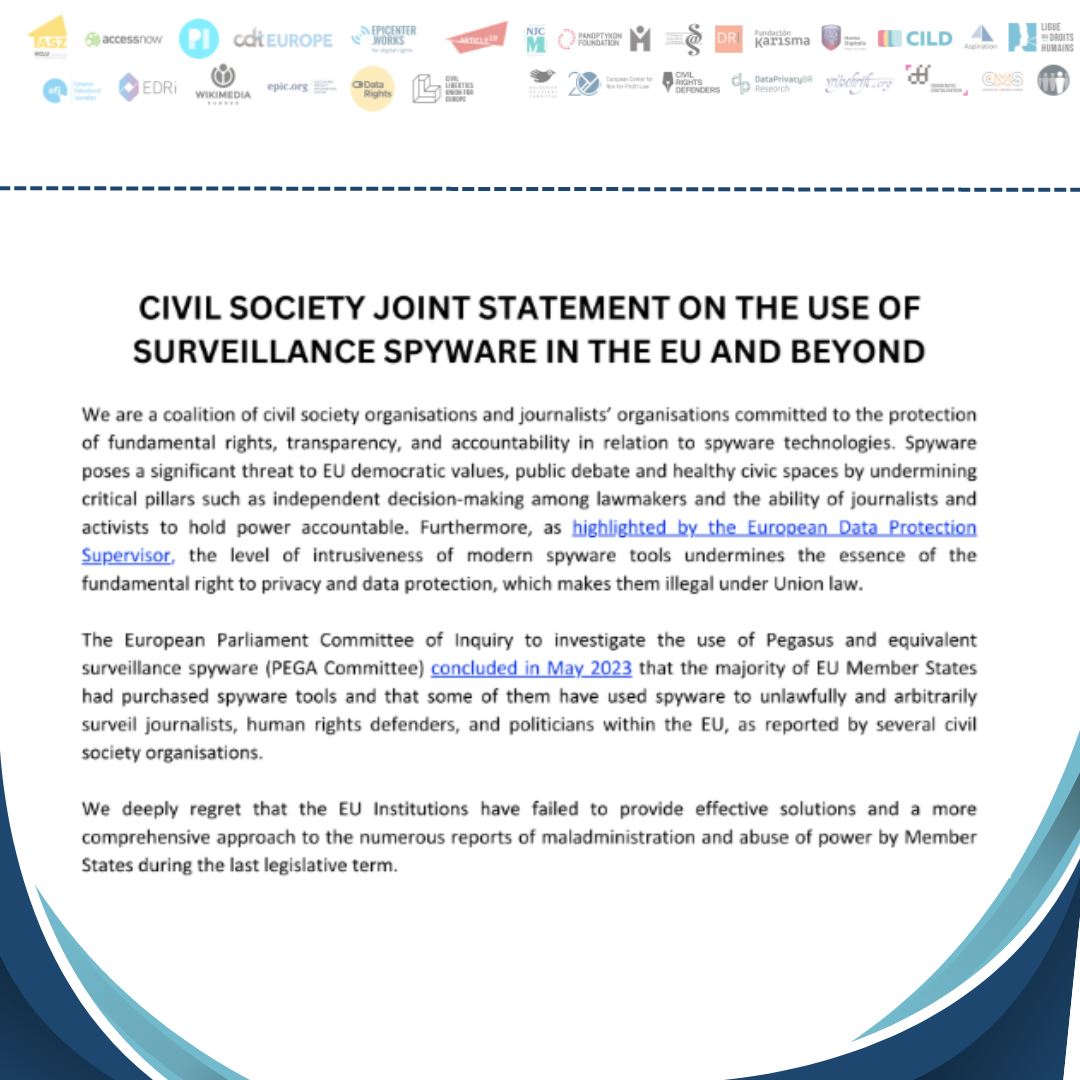
Civil Society Common Statement: United Against Spyware Abuse in the EU and Beyond
Spyware isn’t just a privacy issue — it’s a threat to the very foundations of our democratic values. By undermining independent decision-making, restricting public debate, and silencing journalists and activists, spyware erodes the pillars of a healthy civic space.
As new European Union institutions prepare to take office following the EU elections, the growing threat of spyware has become a pressing global concern that demands immediate attention.
On Tuesday 3/9, Homo Digitalis joined Center for Democracy and Technology Europe (CDT Europe), alongside 30 civil society and journalists' organisations in publishing a joint statement urging the incoming EU institutions to prioritise action against the misuse of spyware in the new legislative term.
Some of our coalition’s key recommendations include:
- A ban on the production, sale, and use of spyware that disproportionately harms fundamental rights.
- Stronger export controls to prevent the misuse of these technologies beyond the EU.
- Transparency and accountability in government contracts involving spyware.
As Silvia Lorenzo Perez, Director of CDT Europe’s Security, Surveillance & Human Rights Programme, puts it: "The incoming EU institutions have the opportunity to correct the failures of the last legislature by taking concrete and decisive action against the abuse of spyware surveillance."
The new EU institutions must seize this moment to restore public trust, protect our fundamental rights, and uphold the values that define the Union.
You can read the EN version of the letter here, and the EL version of the letter here.
Homo Digitalis has also addressed related concerns, before the Council of Europe’s Commissioner for Human Rights in a recent Open Letter submitted in August. You can read more about this here.