

Homo Digitalis signs EPIC's Universal Guidelines for Artificial Intelligence
Today «Electronic Privacy Information Center» (EPIC) published the Universal Guidelines for Artificial Intelligence, in Brussels at the Public Voice symposium “AI, Ethics, and Fundamental Rights.” The symposium is part of the 40th International Conference of Data Protection and Privacy Commissioners (ICDPPC 2018).
The Universal Guidelines set out 12 principles to “inform and improve the design and use of AI. The Guidelines are intended to maximize the benefits of AI, to minimize the risk, and to ensure the protection of human rights.
Homo Digitalis is one of the organizations and experts around the world that has signed and endorsed EPIC’s Universal Guidelines for Artificial Intelligence.
You can access the full document and the list of endorsements here.
You can access the related press release here.

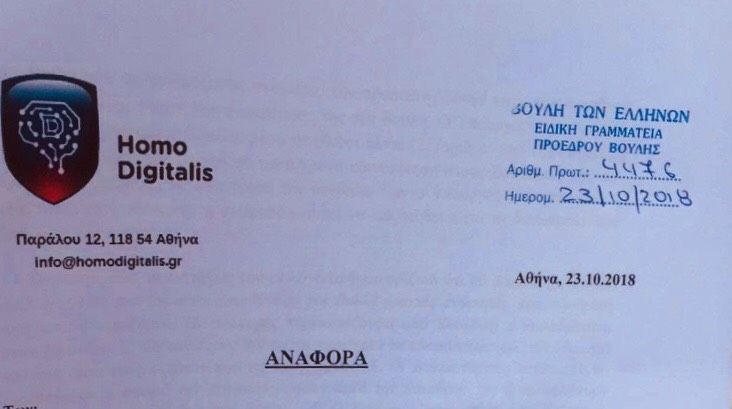
Homo Digitalis submits a report to the Greek Parliament for the negotiations concerning ePrivacy
On 23/10/18 in the context of the negotiations for the reform of the established legislature (Directive 2002/58/EC) with regard to the processing of personal data and the protection of privacy in digital communications, Homo Digitalis submitted a report to the President and the Vice-Presidents of the Greek Parliament, posing specific questions to the responsible Minister.
The questions as they were submitted in the report:
- Given the growing importance of the principles of protection of privacy already from the design and the protection of private life from scratch for the security of the integrity and credibility of digital communication, the Greek Government supports the adaptation of these principles in the text of the proposed European regulation for the protection of private life in digital communications?
- Given the important decisions taken by the Court of the European Union concerning the retention of data produced or being subjected to processing in light of the provision of available ones to the public of the services of digital communication —(ECJ, Joint cases C-293/12 and C-594/12, Digital Rights and others, 8 April 2014, and ECJ, Joint cases C-203/15 and C-698/15, Tele2 Sverige AB v. Post- och telestyrelsen and UK Home Office v. Tom Watson and others, 21 December 2016)—-, the Greek Government vouches to oppose in any kind of reform of the text of the proposed European Regulation, which will diverge from these decisions?
- Given the need of a common legal framework, which will regulate with clarity the private data processing and the protection of privacy in digital communications, the Greek Government believes that the creation of 2 different and diverge legal frameworks for communications, one that will regulate the communications having an impartation role and a second which will regulate communications stored inside the companies providing digital communication services, consists a correct approach of the legal issues that may derive?
- Finally, given the need of the creation of a special legal system which will empower the provisions of the GDPR and will provide with enhanced protection concerning the private data processing and the protection of privacy in digital communications, does the Greek Government guarantee for the fast finalization of the negotiable text of the European Regulation for the protection of privacy in digital communications?
Homo Digitalis encourages the Greek Parliament members to adopt this Report.
At the same day Homo Digitalis submitted a letter to the Minister of Justice, Mr. M. Kalogirou.
You can see the full content of the Report in Greek HERE.