Connecting or cutting the chain?
The European Union has to face its choices
By Stefanos Vitoratos
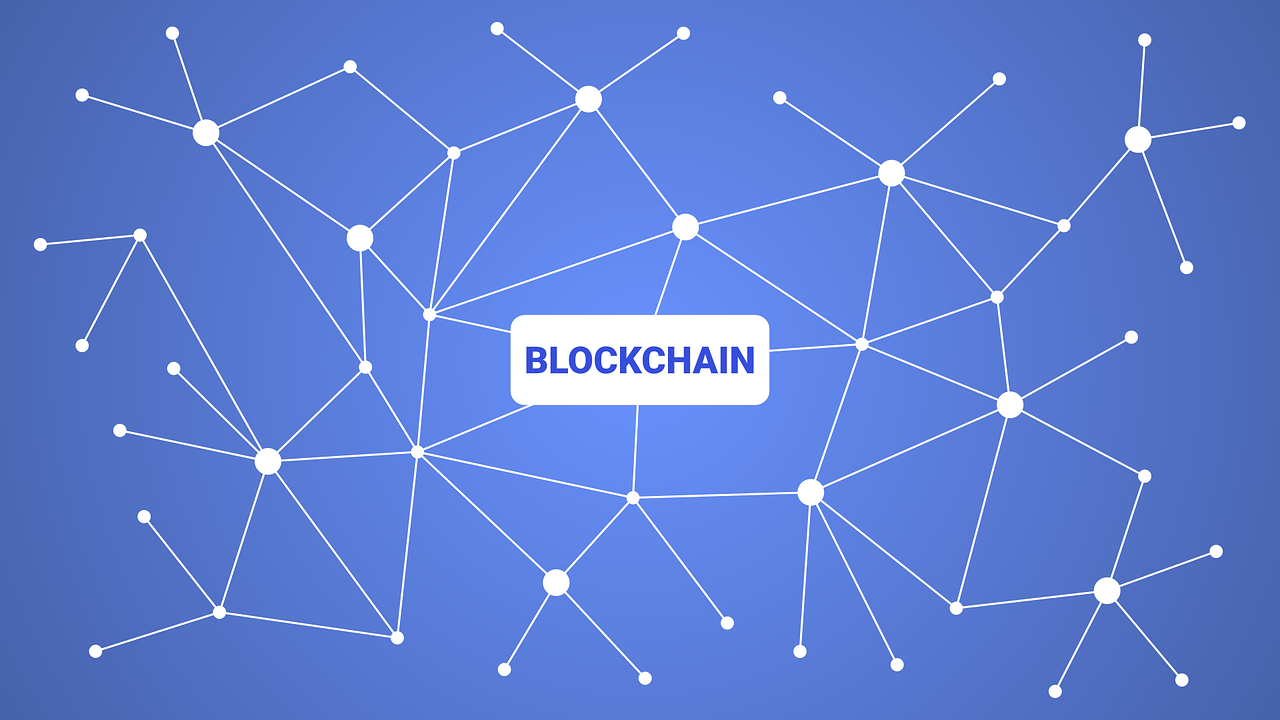
All of us who are somehow concerned with technology, have undoubtedly faced the term “Blockchain” recently. Permitting the distribution of information, but not its copying, blockchain has started to support the backbone of a new form of revolution of information.
Although we got acquainted with blockchain mostly through Bitcoin, it is applicable beyond cryptocurrency.
Energy networks, the health sector, the banking sector, supply chains, transports, education, industry and the public sector are only some of the sectors, on which the application of blockchain is becoming examined on a pilot basis.
Blockchain redefines the role of faith in transactions and in this way it makes intermediaries less necessary.
What is the view of the European Union? Will it become part of this chain? Let us start from the beginning.
What does Blockchain mean?
This technology is based on the notion of the simultaneous creation and sharing of information. This logic is that of a digital file; let us think of something like a ledger. Every user records a transaction and then another one, thus slowly creating a record block. Every new record block is daisy-chained with the previous one, thus creating a blockchain.
Processing this model is by default decentralized, since every user who confirms the previous records and adds a new one, acts from his own computer, while the chain is common to all participants, since all of them save a copy for processing.
The faith of the transactors is based on an algorithmic relation-confirmation, rather than the traditional protection offered by a third person, which is theoretically trustworthy, such as a bank. Therefore, to put it briefly, blockchain is a cryptographically secured transaction file, which functions without a centralized authority interfering.
The difference to what we already know is that blockchain’s database is not saved centrally. The files kept are public and data are always verifiable because of the uninterrupted chain of records, hosted by millions of computers at the same time. Therefore, no block of the chain can be destroyed or amended, since such an action would require the use of tremendous computer power, capable of beating the whole network of the connected users.
Public access to blockchain safeguards transparency in transactions and diffusion of information. In the same context, the need for intermediaries, who augment the costs, disappears, since all the information related to the transaction are encrypted in the blockchain.
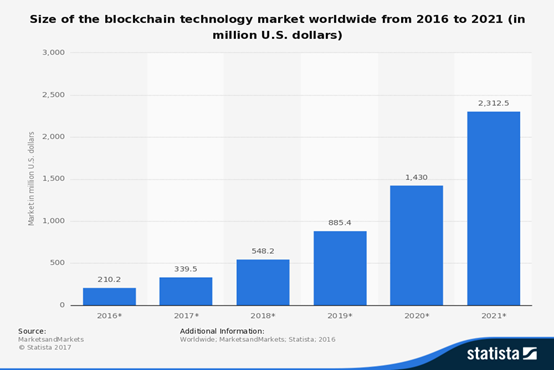 Evolution of the blockchain technology market in $, Source: Statista
Blockchain and human rights
As already mentioned, blockchain as we got to know it through cryptocurrency, as well as the rationale of this technology can enhance human rights protection. Think of a world where each information is public and constantly verified. Imagine how transparency could be endorsed if, for instance, the pharmaceutical supplies of hospitals, were stored in blockchain.
It is indicative that some first attempts have initiated. The UN World Food Programme (WFP), in order to alleviate the refugee crisis, in 2017 provided more than 10,000 Syrian refugees a sum in cryptocurrency, which they could use only to buy food.
The reason why blockchain was selected as a means for sharing was that the refugees, being displaced, neither had access to bank accounts nor had the opportunity to open an account rapidly in the new country where they were installed. Thus, an electronic purse was opened for everyone and the money was deposited there.
Therefore, not only did they have access to their account from anywhere in the world, but also money was saved; money which would have been paid to bank commissions for wire transfers.
Where does the EU stand?
The European Union made a step towards claiming the role of the world leader in the fourth Industrial Revolution -as it is called- through adopting a resolution for blockchain technology on May 16, 2018.
The Committee for Industry, Power and Technology of the European Parliament voted for the resolution (with 52 votes in favour, 1 against), in an initiative by the Greek Member of the European Parliament, Eva Kaili. This was the first time that an institutional organ, such as the European Parliament, discussed the potential form of a regulatory framework for the new decentralized technologies, such as blockchain.
The aim is that the relationship, which is being cultivated through this resolution, becomes the vehicle for cooperation of the Member States. In particular, the exchange of experience and expertise in technical and regulatory fields will prepare the planning of european applications of the blockchain technology in favour of the public and private sector, which will ultimately be in favour of the European citizens.
The question is how can blockchain technology comply with the GDPR, which was adopted to protect the data of the users from central entities. What is not properly answered is what happens with decentralized technology.
As mentioned above, transactions in blockchain are unchangeable. Neither can the transactions change, nor can the data be deleted, since this will “break the chain” in a way, rendering the whole blockchain non functional. At the time, the GDPR prohibits the potential storing of personal data in data chain.
Making a brief flashback, the GDPR was proposed for the first time by the European Commission in 2012 and focused mainly on cloud computing and social media.
More specifically, the GDPR, in its Article 17 introduces the “right to be forgotten”, meaning the right of persons to request the erasure of their data, thus requiring that there will be central servers which will be able to “erase” this data.
The Regulation was drafted without taking into account the blockchain technology, which was not commonly known -even as a word. Therefore, there arises an important question on whether blockchain technology can function properly, without violating the EU legislation, since a fundamental -and at the same time revolutionary- element of blockchain is that data cannot be deleted. In the way that the GDPR has been drafted, it seems that we cannot store personal data directly in the blockchain, since in the words of the GDPR these data “will not be erasable”.
At this point it must be noted that we refer to public chains, not private ones, such as the ones that a company can use for internal reasons; the latter can be created from scratch with a provision of limited/locked access by the public.
Looking into the future
When the European policy makers were discussing and finalizing the GDPR, the blockchain was not in the radar of most people.
What is obvious is that in the future we will need a flexible governance framework, which will permit us to understand the advantages of data and technology.
Governments should cooperate with society, academics and the private sector for policy to conform with such a dynamic procedure, as technology.
With the new initiatives it seems that the legislator understands that blockchain technology is able to create a system structure, in which existing business models could go forward and design a new value chain.
Through the resolution, new roads of regulatory and legal certainty for investing vehicles based on blockchain are opened, confronting serious cases of fraud and unreliability.
The very promising blockchain technology is expected to create a radically innovative ambience for the neuralgic industries and the operational structure of the public sector, while also changing our lives as consumers and citizens in general.Undoubtedly, it seems like a very complex technology. But, let us keep in mind that it constitutes the most feasible, from a technical perspective, attempt for liberation and democratization of the global economic transactions. We expect the developments and wait to see how will the EU comply with its choices.


Reddit was hacked
Both people and the State can become victims of a cyber-attack. Regardless of the security measures everyone uses, there will always be a team of talented hackers, which might be able to take advantage of some human mistake or a weakness in the installed cybersecurity systems and successfully hack them after persistent efforts.
The latest victim of such a cyber-attack is the Internet platform “Reddit”, which is one of the most well-known platforms of informations exchange in the Internet, having hundreds millions users.
According to the official press release by the company, published yesterday (01.08.2018), some hackers got access to the computer systems of the platform and thus, gained access to users’ personal data, including e-mail accounts, encrypted passwords and personal messages exchanged through the platform during the first years of its existence (2005-2007).
Additionally, the intruder gained access to recent files (dated form 3 to 17 June 2018), which the company sent as recommended material to its users. These files contain the users’ username, as well as the e-mail address associated with these usernames, while the recommended material is based on popular content of the platform and on content which is supposed to fit the users’ preferences.
The cyber-attack allegedly occurred quite recently, probably between 14 and 18 June 2018. In its official press release, Reddit states that it is running an investigation since 19 June 2018 to see the full range of the intrusion. Moreover, it has reported the attack to the responsible authorities and has contacted the users, who have been influenced by this attack, through e-mail.
This news reminds us that not only the owners of computer systems are the victims of cyber-attacks, but also the data subjects of the data contained in these computer systems.
The protection of digital rights, such as privacy, protection of personal data and the freedom of online expression and information, is intrinsically linked to the security of the computer systems and the adoption of the pertinent techniques or organizational measures, which guarantee the requisite protection.
You can read the official press release by Reddit here.